Top Boron Carbide Materials for High-Performance Armor and Abrasives
2026-09-11
When a projectile hits a lightweight plate and stops dead, boron carbide is usually the reason. It is one of the hardest materials ever produced, yet light enough for body armor and tough enough for high-pressure abrasive blasting. The challenge is that not every grade behaves the same under extreme conditions. This guide covers the top boron carbide materials for armor and abrasive applications, with a close look at the grades offered by HUAYI TECH.
Why Boron Carbide Keeps Winning in High-Stakes Ballistic Armor
Boron carbide has remained the go-to ceramic for ballistic armor because it pairs extreme hardness with surprisingly low weight. That combination matters more than most people realize: a plate that stops a rifle round but forces the wearer to sacrifice mobility isn't much use in a drawn-out engagement. With a density around 2.5 grams per cubic centimeter, boron carbide sits well below alumina and even below silicon carbide, yet its Vickers hardness routinely lands above 30 GPa. That means less mass for the same level of protection, and anyone who has carried armor for hours understands why that trade-off wins.
The other reason it keeps winning is less about static numbers and more about how it behaves under stress. When a high-velocity projectile strikes, boron carbide doesn't just shatter randomly; it forms a confined damage zone that absorbs energy through microcracking and phase transformation. Modern hot-pressing techniques have also reduced the porosity that once led to brittle failures against repeated hits. The result is a material that stops threats reliably enough for aircraft, vehicle spall liners, and personal plates—without the weight penalty that would make the protection pointless in the field.
Grain Size, Purity, and the Real Limits of Hardness in Abrasives
Abrasive hardness is often quoted as a single number, but that figure rarely survives contact with a real workpiece. Grain size alters how a particle fractures under load. Very fine grains can deflect or pull out before they cut, while coarse grains may cleave along weak planes and lose their edges. The practical hardness of an abrasive is therefore not just a material property; it is a compromise between resisting deformation and surviving the stress of repeated impact.
Purity sets another boundary. Metallic inclusions, residual flux, or unintended secondary phases soften the grain or create crack initiation sites. Even in high-purity materials, vacancies and dislocations remain, so the theoretical hardness of a perfect crystal is never reached. What we call the real limit is an engineering ceiling: the point where further refining size or chemistry yields diminishing returns because the abrasive's own internal flaws, not the workpiece, start governing failure.
Hot Pressing vs. Reaction Bonding: Choosing a Boron Carbide Route
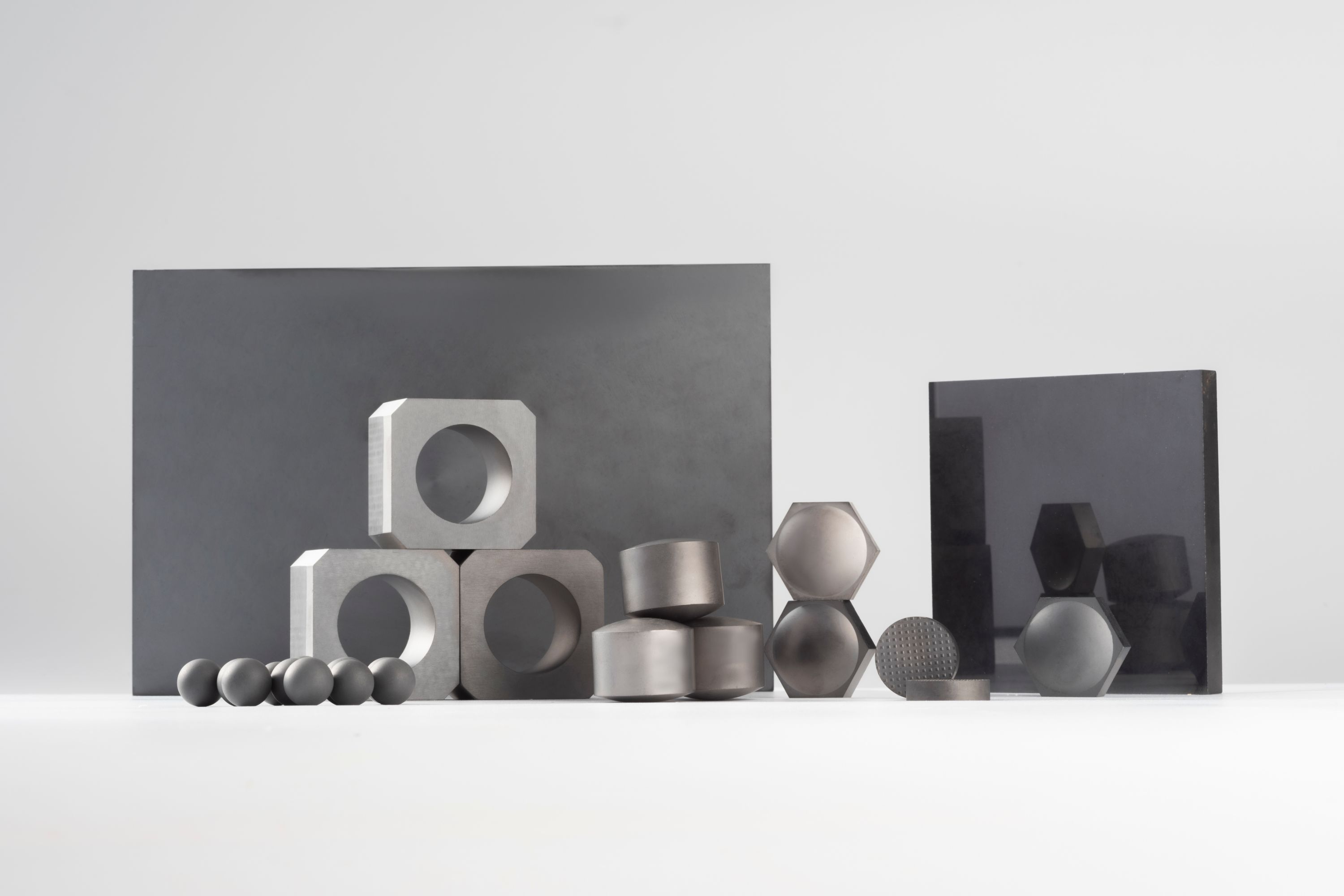
Hot pressing and reaction bonding represent two fundamentally different paths to dense boron carbide ceramics, each leaving its own fingerprint on the final microstructure. Hot pressing consolidates pre-synthesized B4C powder under simultaneous high temperature and uniaxial pressure, typically yielding near-theoretical density with minimal porosity. The resulting material is prized for its hardness and ballistic performance, but the process restricts you to simple shapes like plates or tiles, and machining those shapes is neither cheap nor fast. Reaction bonding, by contrast, infiltrates a porous carbon or boron carbide preform with molten silicon. The silicon reacts with carbon to form secondary SiC, bonding the original grains together while filling residual voids. You end up with a composite that often contains free silicon, which lowers hardness compared to fully dense hot-pressed B4C but allows production of complex near-net-shape parts without extensive diamond grinding.
Choosing between the two routes usually comes down to geometry, budget, and what you can tolerate in terms of performance trade-offs. If your application demands maximum hardness, high elastic modulus, or resistance to extreme abrasion, and the part geometry is relatively flat or can be wire-cut from a billet, hot pressing is hard to beat. The cost per cubic centimeter can be steep, but you are paying for purity and density. On the other hand, if you need a lightweight ceramic with good ballistic protection, wear resistance, or neutron shielding capability in a complex shape—say a curved torso plate insert or a custom crucible—reaction bonding becomes attractive. The residual silicon phase reduces hardness and high-temperature strength compared to hot-pressed B4C, but it also imparts a degree of toughness and simplifies joining to metal components via brazing.
One practical approach is to use reaction-bonded boron carbide for prototyping or low-volume complex parts, then switch to hot pressing for production runs where post-machining costs can be amortized. Another consideration is temperature stability: hot-pressed B4C retains its mechanical properties to much higher temperatures, whereas the free silicon in reaction-bonded material softens above roughly 1400°C. Whichever route you choose, be clear about your operating environment, tolerance for second phases, and downstream processing capabilities—because the decision shapes not only the ceramic itself but also the entire manufacturing chain that follows.
The Weight-Cost-Performance Triangle Every Armor Buyer Faces
Most armor conversations start with a simple question: how much protection do you actually need? The answer runs into physical and economic limits pretty fast. You can have extremely light plates that stop high-velocity rifle rounds, but you will pay a steep premium and may sacrifice long-term durability or multi-hit consistency. You can keep the price low, but then weight and bulk climb, or the threat rating drops. That tension is the real trade space, and it rarely offers a clean win.
Materials tell the story better than spec sheets. Polyethylene plates are light and perform well against many rifle threats, yet they cost more and can be thicker. Steel plates are affordable and thin, but they weigh more and create fragmentation concerns. Ceramic-composite designs sit in the middle, balancing weight and cost while adding complexity. Once you decide on a threat level—handgun, rifle, or special threats—you are really choosing which corner of the triangle you can live without.
A common mistake is buying armor for an imaginary scenario instead of the one you actually face every day. If you wear plates for eight hours in a vehicle, weight and flex matter more than fringe ballistic ratings. If the gear sits in a trunk most of the year, spending extra for ultra-light materials may not make sense. Know your daily load, your likely threats, and your budget before comparing products; otherwise, you will end up paying for a compromise that helps no one.
Boron Carbide Powders for Lapping, Grinding, and Waterjet Cutting
Boron carbide ranks among the hardest materials available in commercial powder form, sitting just below diamond and cubic boron nitride. That hardness, combined with a relatively low density, makes it an efficient abrasive for lapping and grinding operations where aggressive cutting action must be balanced against minimal contamination of the workpiece. In waterjet cutting, fine boron carbide grades deliver a concentrated stream of high-integrity particles that slice through ceramics, glass, and hardened alloys without the thermal distortion often associated with laser or plasma methods.
For lapping and grinding, the performance of boron carbide hinges on controlled particle size distribution and predictable friability. The grains fracture at just the right rate to continuously expose fresh cutting edges, preventing glazing on laps and keeping stock removal steady over long runs. Surface finishes in the single-digit microinch range are achievable on hard metals and technical ceramics when paired with compatible carriers and coolants.
Waterjet systems benefit from boron carbide's ability to maintain sharp particle edges under extreme nozzle pressure. The powder mixes uniformly into the water stream, reducing clogs and pressure drops while producing narrow kerfs with clean edges. Because boron carbide does not react with most workpiece materials, it leaves little residue that could interfere with downstream bonding, coating, or inspection steps.
Detecting Subpar Material Before It Reaches the Battlefield or Workbench
Every batch of raw stock carries hidden flaws that only reveal themselves under stress—micro-cracks from premature cooling, inclusions trapped during casting, or uneven heat treatment that weakens a load-bearing section. Rather than waiting for a failed test coupon or, worse, a field breakdown, forward-thinking teams now scan incoming plate, bar, and forging stock with phased-array ultrasonics and eddy-current arrays. These tools map internal discontinuities in minutes, flagging suspect zones before a single chip is cut. The goal isn’t just to reject bad metal; it’s to understand which supplier lots trend toward porosity so procurement can adjust before a production run stalls.
The same principle applies to polymer and composite stock, where voids, resin-starved regions, or delaminations often hide below the surface. Terahertz imaging and laser shearography offer non-contact ways to spot these anomalies without destroying the sample. A fabricator making blast-resistant panels, for instance, can scan a full sheet of ultra-high-molecular-weight polyethylene in seconds, flagging areas where fiber orientation drifted or bonding pressure dipped. Instead of relying on statistical sampling that misses isolated defects, the entire incoming inventory gets a baseline quality fingerprint.
What makes this shift practical is how quickly the data ties back to the shop floor. When a scan flags a suspicious inclusion in a titanium billet intended for a turbine bracket, the operator can isolate that section, cut around it, or return the lot before machining hours are wasted. No one wants to discover a void after a five-axis mill has already spent three hours profiling a part. By moving detection upstream—before workholding, before toolpaths, before the first spark—teams stop betting their schedule on material that was never going to hold up.
FAQ
Its hardness sits just below diamond and cubic boron nitride, while its density stays around 2.52 grams per cubic centimeter. That combination gives it a higher specific ballistic efficiency than most other ceramics, meaning it stops projectiles without adding the weight that alumina or silicon carbide would. For helicopter and body armor, that weight saving is often the deciding factor.
Grain size distribution, purity, and sintering additives are the main differences. Finer, tightly graded powders with low free carbon and minimal metallic impurities cut more uniformly in lapping and blasting. Coarser fractions end up in rough grinding or as raw feed for hot-pressed plates, where a wider spread can actually help densification.
Alumina is cheaper but heavier and softer. Silicon carbide is harder than alumina but denser than boron carbide and can fail more abruptly under repeated hits. Boron carbide gives the best protection-to-weight ratio against armor-piercing threats, although its cost is higher and it can lose strength locally when hit by very high-velocity projectiles due to amorphization.
Powder purity should be above 98.5 percent, with a boron-to-carbon ratio close to four to one and low oxygen content. Particle size needs to be consistent because it affects how evenly the powder densifies. Ask for sintered density above 98 percent of theoretical and, ideally, ballistic test results rather than just material certificates. Trace iron and silicon impurities can also shift hot-pressing behavior in ways that hurt repeatability.
Yes. Hot-pressed monolithic tiles are standard in rigid vehicle armor, but the material also appears as a strike face over metal or aramid backings and as a powder filler in ceramic-polymer composites. In composites, the particle size and volume fraction control energy absorption and multi-hit performance more than the ceramic chemistry alone.
Boron carbide keeps its hardness at elevated temperatures better than many alternatives, which is why it appears in high-speed grinding and cutting of hardened steels. Oxidation becomes noticeable above roughly 600 degrees Celsius, so using coolant or an inert atmosphere extends tool life when the process runs hot.
Boron carbide generally costs several times more than alumina and around two to three times more than reaction-bonded silicon carbide. The higher price comes from raw material synthesis, sintering difficulty, and limited supply. Buyers tend to accept the premium only when weight savings are critical, such as in rotary-wing aircraft or personal protective equipment.
Pressureless sintering with carefully chosen carbon or metal additives, spark plasma sintering, and reaction bonding are all being refined to cut porosity and raise fracture toughness. Some producers also apply thin ceramic or polymer coatings to delay the impact-induced amorphization that weakens boron carbide during high-velocity hits, which has been a long-standing limitation.
Conclusion
Boron carbide remains the default choice in high-stakes ballistic armor not because of a single spec sheet number, but because its combination of low density and extreme hardness lets plates stop rifle threats without the weight penalty of alumina or the brittle unpredictability of some silicon carbides. However, the material is only as good as its microstructure. Grain size and purity set real limits: large grains or residual free carbon create crack paths that drop multi-hit performance, and even a nominally correct chemical formula cannot compensate for poor sintering. That is why hot pressing, despite its higher energy cost, is preferred over reaction bonding for armor-grade tiles. Reaction-bonded boron carbide often contains residual silicon and a coarser pore network, which lowers hardness and fracture toughness just enough to matter in a life-or-death scenario.
Abrasive buyers face a different but equally unforgiving set of trade-offs. The weight-cost-performance triangle is not just about armor; lapping, grinding, and waterjet cutting powders demand tight particle size distributions and high chemical purity to avoid scratching or contaminating workpieces. A cheap powder with a wide size spread will cut unevenly and wear down tooling faster than a premium, classified lot. Before any of this material reaches a battlefield or a workbench, it can be screened with simple checks: apparent density, acid solubility, and microhardness indentation under a calibrated load reveal porosity, unreacted carbon, or overgrown grains that would otherwise go unnoticed. Experienced buyers learn to distrust a certificate of analysis alone and instead validate a few incoming lots themselves, because subpar boron carbide rarely announces itself until it fails.
Contact Us
Contact Person: Junting Leo
Email: [email protected]
Tel/WhatsApp: +86 18615009766
Website: https://www.huayimaterial-china.com/