
Professional Column Still: Mastering Precision Distillation for Superior Spirits
2026-10-12
Ask any distiller what separates a good spirit from a truly exceptional one, and they'll tell you it's not just the ingredients—it's the precision of the distillation itself. That's where a professional column still comes in, turning raw wash into a refined canvas of flavor. With DYE's engineering at its core, mastering this precision isn't just a technique; it's the key to unlocking superior spirits that stand out on any shelf. Here's what you need to know to take your craft to the next level.
How Plate Count and Spacing Shift the Flavor Profile Compared to Pot Stills
A pot still gives a single, broad pass: the vapor carries whatever boils off at that moment, from oily fusel alcohols to floral esters, with very little separation. A column still with multiple plates changes that by forcing the vapor to condense and re-evaporate again and again. Each plate acts as a small distillation stage, so the more plates you add, the sharper the cut between fractions. That means heavier, oilier compounds and harsh sulfur notes stay lower in the column while the final spirit comes off lighter, cleaner, and more narrowly defined. Push the plate count high enough and you can strip nearly all of the character away, which is why grain neutral spirits and vodka often use tall columns.
Plate spacing matters because it changes how long the liquid sits on each plate and how much copper contact the vapor gets. Wider spacing lets the reflux pool breathe a little, giving more time for catalytic reactions that soften sulfury, rubbery notes and build a few fruity esters. It also reduces entrainment, so heavier droplets don't get carried upward as easily. Tighter spacing speeds things up and can emphasize lighter, more volatile aromatics, but it may also leave a more angular, thinner spirit if not balanced properly. In practice, a distiller who wants a rounder, more integrated profile will often reduce plate count or increase spacing to keep some of the heavier, textural compounds in play.
Compared to a pot still, plates don't just purify the spirit; they give you a way to steer the flavor gradient rather than accept whatever the wash offers in one pass. Where a pot still might deliver a wide, rustic, occasionally aggressive spirit, a plated column can be tuned to select a narrow band of esters, higher alcohols, and spice notes while still leaving enough body to remain interesting. The real shift comes from deciding how much separation you want: a short, wide-spaced plate section behaves almost like a hybrid, keeping some pot-still depth while adding a cleaner top end. Too many plates or too little spacing, though, and the spirit drifts toward neutrality, losing the very thing that makes a distillery's profile recognizable.
Fine-Tuning Reflux Ratios for a Cleaner Spirit Without Overcomplicating the Run
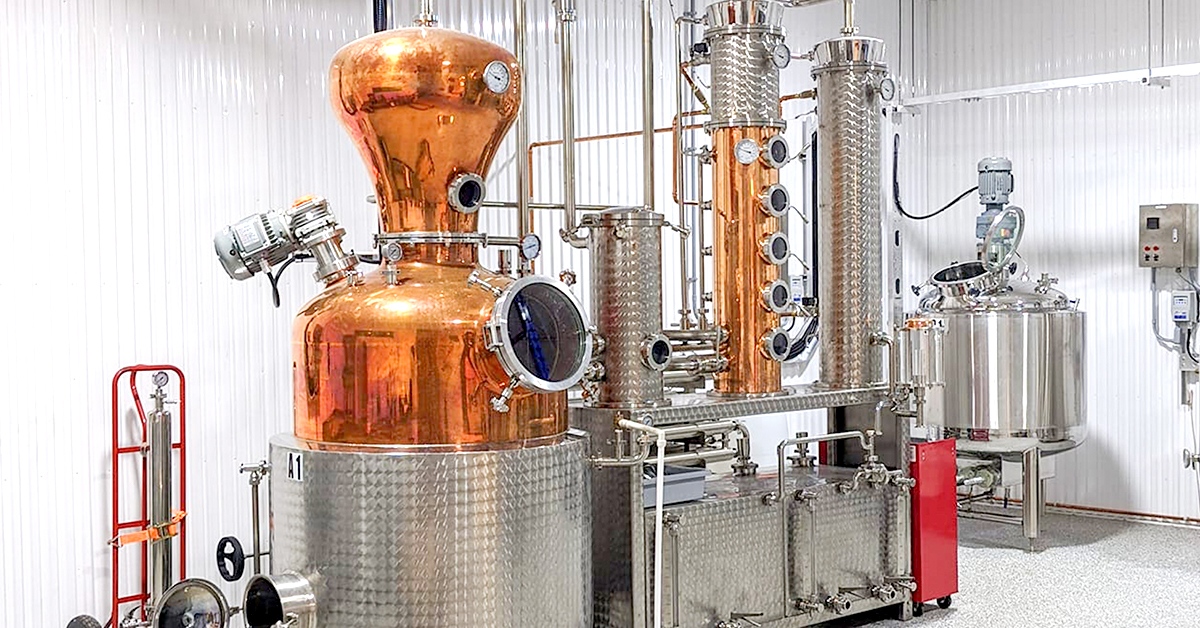
You don't need a spreadsheet to find the right reflux ratio. Start with whatever setting your rig ran last time, then nudge the takeoff valve a quarter turn and watch what happens at the parrot. A slower drip that smells sweeter and less like wet cardboard usually means you're heading the right direction. If the output speeds up but the nose gets sharp, you've gone too far. Trust your senses more than the thermometer.
Small changes beat big swings. Dropping the ratio by 10 or 15 percent is enough to clean up tails without stripping away the grain or fruit character you actually want. Give each adjustment ten to fifteen minutes to show its effect before touching anything else. Rushing leads to overcorrection, and then you're chasing your own tail for an hour.
There's no perfect number, only the ratio that fits your still, your wash, and the spirit you're making. Once you hit a run where the hearts come off clean and the transition to tails is obvious, write down that setting in pencil. Next run, start there and refine if needed. That's all fine-tuning has to be.
Managing Heat Input and Feed Rates to Prevent Off-Notes and Congeners
Heat input is rarely a set-and-forget variable. When the still is pushed too hard early in the run, a surge of vapor can carry heavier fractions into the condenser before the column has found its equilibrium. Those fractions often include acetaldehyde and ethyl acetate, which read as sharp, solvent-like notes. Dialing back the energy at the first sign of a fast head temperature climb gives the column time to stack the lighter compounds at the top, where they belong, instead of smearing them through the hearts.
Feed rate matters just as much, especially on continuous or hybrid systems. A feed that enters too quickly cools the plates below their working range, while a trickle can overheat the upper section and pull tails forward. The trick is to match feed rate to the heat you are removing, not just the heat you are adding. Operators who watch the pressure drop across the column and adjust feed in small increments tend to hold a cleaner cut line than those who chase temperature alone.
Preventing off-notes is less about hitting an exact number than about keeping the vapor speed steady. Congeners like fusel alcohols and fatty acids become more mobile when the vapor is turbulent. Slowing the feed slightly or reducing steam for ten or fifteen minutes can quiet the system enough to let those heavier compounds fall back into the boiler. The result is a middle cut with fewer harsh edges and less need for carbon polishing later.
Choosing Column Height and Packing Materials for Long-Term Consistency
Getting the column height right isn't just about fitting the space in your lab; it's about the quality of separation you can expect months down the line. A column that's too short might save bench space initially, but you'll quickly find your resolution dropping as the packing settles and channels form. On the other hand, an overly tall column can introduce excessive backpressure and make packing uniformly difficult, leading to dead zones that only become obvious after repeated runs. The sweet spot often lies in matching the column length to the particle size of your packing material—smaller particles pack more densely and can achieve high efficiency in shorter beds, while larger particles may need that extra height to compensate for lower plate counts.
Packing material choice goes hand in hand with column height. If you're working with silica for normal phase or C18 for reversed phase, the physical robustness of the particles matters as much as their chemistry. Irregularly shaped silica can crush under the weight of a tall column, creating fines that clog frits and change flow characteristics over time. Spherical particles, though often pricier, maintain their integrity better across repeated pressure cycles. For long-term consistency, it's worth investing in a packing that's been pre-treated or end-capped to resist hydrolysis, especially if your mobile phase leans toward the acidic side. Without that, you'll see retention times drifting as the stationary phase slowly degrades.
Another factor that gets overlooked is the packing procedure itself. Even the best materials will underperform if the column isn't packed with a consistent slurry density and pressure. For reproducible results over months, you want a packing that settles predictably, without requiring heroic efforts to avoid voids. Some chemists swear by dry packing for larger columns, but wet slurry packing tends to give more uniform beds for analytical work. Whichever route you choose, document your packing method meticulously—small differences in how you pour or vibrate the column can show up as tailing peaks later. Consistency in packing is the quiet partner to your choice of height and material, and without it, even the most carefully selected column will betray you when you least expect it.
Troubleshooting Common Column Still Issues Before They Ruin a Batch
Running a column still demands constant attention, because small problems have a way of snowballing into ruined distillate before you even realize what hit you. One minute the vapor temperature is steady, the next it spikes or dips without warning, and suddenly your cuts are all over the place. If the reflux condenser isn't knocking down enough vapor, you'll see a sharp rise in head temperature and a thin, harsh stream coming off the still. The fix often means backing off the heat slightly or bumping up the coolant flow, but you have to act fast. A few degrees of drift can pull tails into what should have been a clean hearts cut, and once that happens there's no un-mixing it.
Flooding is another batch killer that creeps up when you push a packed column too hard. You might hear a gurgling or surging sound from the column, or notice the sight glass filling with liquid instead of showing a steady drip. Some distillers mistake the increased output for good production, when actually the column is choking and the vapor path is broken. Easing back on the power input for ten or fifteen minutes usually lets the liquid drain back down and re-establish equilibrium. If you ignore the warning signs and keep cranking, the column will puke into the condenser and carry over all sorts of fusel oils and boiler gunk that no amount of carbon filtering can fully scrub out.
A third issue that flies under the radar is slow or uneven heating from a dirty element or scorched solids in the wash. You'll see the boil start and stop, the column temperature hunting around, and the output stream pulsing instead of running smooth. Before the run, a quick rinse of the heating element or a gentle stir of a settled wash can save you a lot of grief. And if you're using a dephlegmator, make sure the needle valve isn't partially clogged with mineral deposits, because that quietly reduces your reflux ratio and lets smearing happen across the entire run. The best troubleshooting happens before you ever fire the burner, but knowing what to feel for, listen for, and watch for mid-run is what keeps a good batch from turning into a teachable moment you'd rather forget.
Adapting Column Still Techniques Across Whiskey, Rum, and Neutral Spirits
A column still is often viewed as a fixed piece of engineering, but its true value lies in how easily it can be reconfigured for completely different spirits. The same basic hardware can produce a heavy, ester-forward rum one day and a clean, nearly neutral base alcohol the next, simply by changing the number of active plates, adjusting the reflux ratio, or moving the draw point for the product stream. This flexibility makes the column still a workhorse in distilleries that need to switch between whiskey, rum, and neutral spirits without installing entirely separate systems. Understanding which levers to pull is what separates a generic distillery operation from one that can tailor its output to very specific flavor targets.
For whiskey and rum, the goal is usually to retain some congeners and heavier compounds that carry grain or molasses character. On a column still this means running fewer plates, lowering the reflux to allow more high-boiling volatiles through, and often taking spirit from a point lower in the column rather than from the very top. Rum producers in particular might use a single pass through a short column to preserve the funkier, fruitier notes that come from raw cane or molasses fermentation, while whiskey makers often pair a column still with a pot still doubler to strike a balance between efficiency and flavor complexity. The exact settings depend on the wash composition, fermentation time, and the style of spirit being made, so there is no universal recipe—only a range of starting points that a skilled operator adjusts by taste and chemical analysis.
Neutral spirits demand the opposite approach. Here the aim is to strip out almost all flavor and aroma compounds, leaving behind a clean ethanol-water mixture suitable for vodka, gin base, or industrial use. This requires a taller column with many more theoretical plates, a high reflux ratio to repeatedly re-condense and re-vaporize the liquid, and careful control of the feed point and product draw location. Some neutral spirit production uses extractive distillation or additional purification steps like carbon filtration, but the column itself does most of the heavy lifting. The key adaptation is a shift in mindset: instead of trying to capture desirable impurities, the operator runs the still to push everything except ethanol downward and out through the bottoms, yielding a spirit that is technically neutral but still retains a subtle character depending on the raw material and the exact cut points.
FAQ
A pot still works like a batch kettle—vapor rises once, condenses, and you get a spirit with heavy congeners. A professional column still adds a vertical stack of plates or packing that forces rising vapor to mingle with falling liquid reflux. That repeated contact re-distills the alcohol many times before it ever leaves the column, so you can hit 90–95% ABV in one pass while keeping tight control over heads, hearts, and tails.
Each plate or section of packing behaves like a tiny distillation stage. Vapor rich in alcohol rises, cools slightly against the down-flowing liquid, and leaves behind water and heavier compounds. With enough plates and the right reflux ratio, the ethanol concentration climbs step by step. By the time vapor reaches the condenser, most of the water and fusel oils have been stripped away, giving a cleaner, higher-proof spirit without a second distillation.
Column stills shine for vodka, gin base spirit, light rum, and white whiskey where a clean, neutral profile is the goal. They are also used for grain-neutral spirit and some high-ester rum styles if the operator manages the cut points carefully. Heavy, oily spirits like full-bodied single malt or pot-still rum usually prefer a pot still, but a column still can still make an excellent base if you run it with fewer plates and lower reflux.
Plates, usually made of copper or stainless steel, give the vapor a defined number of contact stages—more plates mean more separation. Packing, like structured copper mesh or ceramic saddles, creates a large surface area inside the column for vapor-liquid interaction without the hard stage count. Choosing between plates and packing changes how fast you can run, how much copper contact you get, and how sharply you can separate esters from ethanol.
Reflux is the portion of condensed vapor sent back down the column to wash the rising vapor. Too little reflux and you get smeared cuts, with heads dragging into hearts. Too much and you over-purify, stripping out aromas that give the spirit character. Adjusting the reflux ratio during a run lets you pull out a clean heart, then reduce reflux near the end to collect heavier flavor compounds—if that is the profile you want.
Rinse the column and plates after every run to prevent residual copper salts and yeast from building up. Inspect gaskets and sight-glass seals weekly because a small vapor leak changes pressure and ruins equilibrium. Every few months, disassemble the plates or pull the packing and give it a citric acid bath. Keep the dephlegmator and product condenser clear of scale, and check thermometer probes against a known calibration point so your cut decisions stay accurate.
A column still is not a one-trick machine. If you run it with fewer plates, lower reflux, and late heads cut, you can keep grain, fruit, or molasses notes. Some distillers use a short column or a hybrid setup with a pot still for the first pass and a small column for finishing. The key is recognizing that the column is a tool for shaping flavor, not just erasing it.
The biggest mistake is running a column still like a pot still—full power, minimal reflux, and expecting the same cut points. That usually smears tails into the hearts or floods the plates. Another mistake is ignoring vapor speed; pushing too hard can entrain liquid and carry sulfur compounds up. Finally, many distillers over-rely on temperature readings instead of taste and smell. A column still gives you more levers to pull, but you have to learn which ones matter for each recipe.
Conclusion
Mastering a professional column still means treating every run as a balance between separation and character. Plate count and spacing do more than add theoretical stages; they reshape how heavy congeners cling or drop away, so a spirit can swing from dense and oily to surprisingly clean without changing the mash bill. Fine-tuning reflux ratios is rarely about chasing absolute purity—it's about finding the point where heads compress tightly and hearts stay broad enough to carry grain or cane notes. Managing heat input and feed rates matters just as much, because a steam surge or uneven feed can drag tails compounds into the heart cut long before the still warns you.
Long-term consistency starts with column height and packing materials chosen for the actual workload, not just the spec sheet. Structured copper packing can smooth out sulfides in whiskey, while stainless mesh in a taller neutral column keeps things predictable run after run. Troubleshooting common issues—flooding, weeping, pressure swings, or a drifting reflux split—usually comes down to reading temperature gradients before they ruin a batch. Finally, adapting column techniques across whiskey, rum, and neutral spirits means knowing when to strip hard and when to slow down: a rum may want a looser cut with more esters, whereas a neutral demands tighter fractions and a longer equilibration.
Contact Us
Contact Person: Ada Xu
Email: [email protected]
Tel/WhatsApp: 0577-86806088
Website: https://www.dayuwz.com/