
MCM Flexible Stone for Interior Walls Factory Insights and Design Inspiration
2026-11-16
Most people assume flexible stone is just a thinner, cheaper imitation of the real thing. But after a walk through Magic Stone’s MCM production line, that assumption crumbles faster than a poorly mixed batch. The way this material bends without breaking, breathes without warping, and mimics textures down to the grain—it quietly unlocks interior wall possibilities that rigid stone simply can’t touch. In this piece, I’m sharing the factory insights I picked up from Magic Stone, along with design directions that made me question every accent wall I’ve ever specified.
Touring the MCM Line Where Flexible Stone Gets Its Flawed Beauty
Walking the MCM line, you see right away that no two sheets of flexible stone come out identical. The raw mineral slurry gets pressed into thin, bendable layers, but the uneven spread of mica flakes and mineral pigments leaves faint streaks and cloudy patches. The factory floor doesn't try to hide these marks; the lighting above the conveyor belt actually makes them more visible, as if the imperfections are part of the inspection checklist.
Each batch gets a quick hand-sanding pass, but only enough to knock off loose grit. The workers know exactly where to stop—too much pressure would erase the very texture that gives the stone its character. A small crack near the edge of a sheet is set aside, not scrapped, because someone will cut around it later and turn that flaw into a natural-looking vein. The line moves at a pace that allows these small judgments to happen.
By the time a sheet reaches the end of the line, the flaws have settled into a pattern of their own. An uneven color shift becomes a soft gradient; a cluster of mineral specks reads as deliberate texture. No one calls it perfect, and that's the point. The flawed beauty isn't a defect to be corrected but a signature of the material's origin, left untouched for the final install.
The Bend Test That Separates MCM Flexible Stone from Cheap Imitations
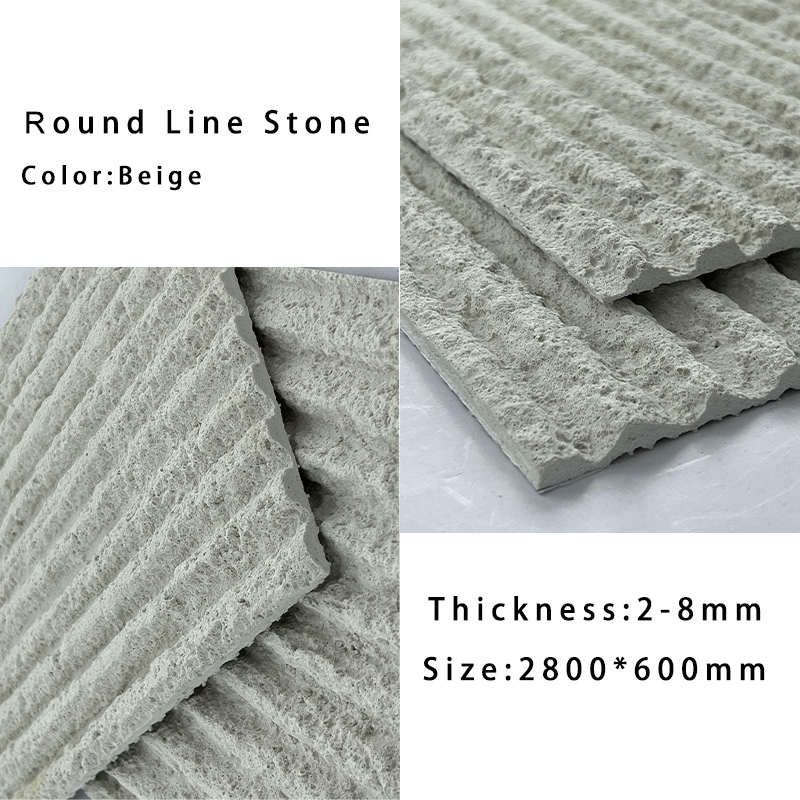
Take a sample of MCM flexible stone and bend it around a mandrel no thicker than a finger. Genuine material arcs smoothly, the surface staying intact without whitening, cracking, or snapping back with a sharp crease. Cheap imitations start to stress-crack almost immediately—fine lines spread across the face, and the resin often turns chalky at the bend point before the piece gives way.
The difference comes down to how the polymer matrix binds the mineral fillers. Real MCM uses a resilient binder that stretches and flexes as one continuous film, so the stone grains move together without separating. Low-cost knockoffs load up on brittle acrylic or polyester binders that cure hard. Under bending force, those rigid bridges shatter, leaving the filler particles to grind against each other and the surface to fracture.
You can run this test on a small offcut before committing to a full installation. Peel back the protective film, wrap the sheet around a two-inch pipe, and hold it for a few seconds. If it survives without visible damage, you're working with material that can handle thermal movement, substrate settlement, and the uneven pressures of everyday wear. If it fails, no amount of surface coating will hide the underlying brittleness.
How Designers Use Flexible Stone to Add Architectural Depth Without Construction
Flexible stone challenges the assumption that adding depth to a surface requires heavy demolition or a new structural layer. Because the material arrives as a thin, pliable sheet with a real stone veneer, designers can wrap it around curved walls, columns, or even furniture fronts. The result is a textured, dimensional look that would normally demand custom masonry, yet it installs with basic adhesive and common tools. This lets a flat drywall plane suddenly read as a sculpted limestone or slate element, entirely through surface treatment.
In practice, the effect often comes from playing with shadow and light. A slight undulation or a sharp corner covered in flexible stone catches illumination differently than painted drywall, giving the eye a sense of mass and weight. Designers use this to define zones in open plans — a reception desk wrapped in a rough stone finish feels anchored, while the surrounding walls stay light. Since no framing or concrete is involved, the depth appears almost like a visual trick: the wall seems thicker, the column more solid, but the original structure remains untouched.
What makes the approach particularly appealing is the removal of typical renovation barriers. There is no need for permits triggered by structural changes, no added floor load, and no coordination with multiple trades. A small crew can resurface a lobby in a day. For adaptive reuse projects or leased spaces where construction is limited, flexible stone offers a way to introduce architectural character that feels permanent and handcrafted, without the cost or disruption of building new forms.
Why Installers Skip the Backer Board with MCM Flexible Stone
Installers often bypass backer board with MCM flexible stone because its thin, pliable body bonds directly to clean, stable surfaces such as drywall, plywood, or existing tile. Traditional masonry veneer relies on a rigid backer to prevent cracks, but flexible stone moves with minor shifts in the substrate, making that extra layer unnecessary. Removing it cuts both labor and material costs on the spot.
Moisture behavior also plays a role. Flexible stone is vapor-permeable and doesn’t trap water the way cement board can in certain wall assemblies. Without the backer, there’s less buildup at edges and transitions, so trim and finish work go faster. Crews finish sooner with fewer return visits.
The Color Lab Inside MCM's Factory That Keeps Every Batch on Point
You could walk past the color lab at MCM's factory and hear almost nothing. Inside, a technician hunches over a small metal booth, holding a swatch of freshly dyed leather next to a faded master sample from ten years ago. The naked eye gets first say, but it rarely gets the final one. A spectrophotometer clicks, spits out a numerical fingerprint of the color, and compares it to the archived standard. A delta value pops up — 0.3, 0.6, 1.2. Anything over 0.8 means the batch is headed back to the mixing tanks. No argument, no artistic debate. Just numbers.
The tricky part isn't matching a single hide; it's matching a batch that will sit next to another batch on a store shelf weeks later. Raw hides arrive with different porosity depending on the season, the animal's diet, even the humidity in the tannery. Dye lots shift. So the lab doesn't just check finished pieces — it audits the color at three stages: after base coating, after top coating, and after finishing. If a pigment drifts, the formula gets adjusted on the spot, not with a generic note but with a precise gram-per-liter correction logged by hand in a notebook that looks more like a mechanic's ledger than a designer's memo.
What keeps every batch on point isn't some secret machine or a proprietary software dashboard. It's the refusal to let a batch move forward while there's still a sliver of doubt. A technician once held up two panels of cognac-brown leather under a daylight lamp and said, "They're the same." Then she turned off the lamp, walked to a north-facing window, and squinted. "Now they're not." Back to the tanks it went. That kind of stubbornness — the kind that trusts both a $40,000 spectrometer and a pair of tired eyes — is why the color lab exists. Not to make colors perfect once, but to make them stubbornly, boringly repeatable.
When to Skip the Accent Wall and Wrap the Whole Room in Flexible Stone
If the room already has strong architectural rhythm—like a run of windows, a long built-in, or a continuous shelf line—an accent wall can feel like a visual stop sign. Wrapping the entire space in flexible stone lets the surfaces flow without interruption, so the eye moves through the room rather than getting caught on one plane.
Small or awkwardly shaped rooms are another case where a single feature wall can shrink the space. Because flexible stone is thin and lightweight, it hugs curves, columns, and uneven corners without bulky buildup. Covering all walls, or even the ceiling, turns odd geometry into a cohesive shell instead of highlighting the weird angle.
When the stone itself has a subtle, tactile grain rather than a loud pattern, full coverage reads like a quiet backdrop rather than a statement. That works especially well in bedrooms, reading nooks, or hallways where you want calm continuity, not a competing focal point. The room feels wrapped rather than decorated.
FAQ
It starts with real mineral pigments and stone particles bonded to a flexible backing, so you get the depth and cool touch of natural stone without the weight or rigid install. Unlike printed wallpaper, there's no repeating pattern—every sheet shows subtle shifts in tone and grit. It can curve around a radius, cut with a utility knife, and goes up over drywall, plywood, or even existing tile if the surface is prepped.
The process usually begins with blending raw clay, stone powder, mineral pigments, and a polymer binder into a slurry. That mix gets spread onto a fiberglass or fabric scrim, then moves through heat and pressure rollers to lock the texture and flexibility. After curing, sheets are trimmed, checked for color drift and bend radius, and stacked with a protective film. The best factories keep batch samples from each run so later orders can be matched closely.
Wrapping a curved bar front is probably the most memorable—because the material bends, you get a seamless stone look over a barrel curve. I've also seen it used inside recessed shelving niches, on a range hood cover, and as a headboard wall in a bedroom where real stone would've been too heavy. Even elevator cab interiors and reception desks work well since it doesn't add much dead load.
It can hold up in humid settings if you choose a product rated for wet interiors and seal the cut edges properly. For a kitchen backsplash, it's solid with a good acrylic or polyurethane adhesive and a final sealer. Showers are trickier—some lines allow it with full waterproofing behind the board and epoxy grout at seams, but I'd request the factory's wet-area spec sheet before committing.
Quite a bit, if the order size supports it. Factories adjust the mineral blend, pigment load, and surface finish to match a custom shade or mimic a specific stone reference. Textures range from a honed, almost leathery feel to a rough split-face look. The catch is minimum order quantities—custom runs might start at a few hundred square meters, so for smaller jobs it's better to pick from existing stock lines and use a custom sealer or tint.
Skimping on surface prep is the big one—uneven walls telegraph through the thin sheet. Using the wrong adhesive is another; solvent-based contact cement can bleed or soften the backing. People also stretch the material too hard over tight outside corners, which can crack the mineral layer. And not sealing cut edges lets moisture creep in over time. Let the sheets acclimate to the room for a day before starting, and test a small patch first.
From a normal viewing distance, most people can't tell the difference—the mineral surface catches light and shadow the same way. Up close, you might notice the edge profile is thinner, so use a metal or mitered trim at exposed ends. It won't have the same mass or resonance as a real stone slab, but you gain a huge reduction in cost, labor, and structural requirements. For accent walls and curved surfaces, it delivers the look without the engineering headaches.
Grazing light is everything. Place a narrow LED strip or linear fixture close to the wall, aiming down or up, so the texture casts micro-shadows. Warm color temperature around 2700K to 3000K brings out earthy undertones. Avoid a single flat ceiling light from directly in front—it washes out the relief and makes the stone look painted on. A mix of a soft wall wash and a few focused spots works best.
Conclusion
Walking the MCM production floor, it's clear the "flawed beauty" of flexible stone isn't an accident. Veins drift and pause, mineral blooms interrupt the surface, and no two sheets repeat exactly—yet the bend test near the end of the line proves this material can fold around a corner without cracking or delaminating. Cheap imitations snap under the same radius, but MCM's version holds a tight curve because the stone layer is bonded to a flexible polymer backing under controlled pressure. That balance between natural irregularity and structural reliability is what lets designers use it as more than a flat veneer. A column wrapped in flexible stone reads as solid masonry, but it takes a fraction of the time and no demolition.
Installers often skip backer board entirely, troweling adhesive directly over drywall or even existing tile—the material's light weight and dimensional stability make that possible. Meanwhile, the in-house color lab tests every batch against a master sample under multiple light sources, so a job ordered six months apart still lands in the same tonal family. For rooms where a single accent wall feels timid, wrapping all four walls in the same flexible stone can turn a small study or powder room into a cocoon of continuous texture, especially with low-sheen finishes that keep the space from feeling heavy. That's where factory control and design ambition meet: a product imperfect enough to feel hand-finished, yet consistent enough to trust across an entire room.
Contact Us
Contact Person: Vito
Email: [email protected]
Tel/WhatsApp: 86 13088879266
Website: https://www.magicstonemcm.com