
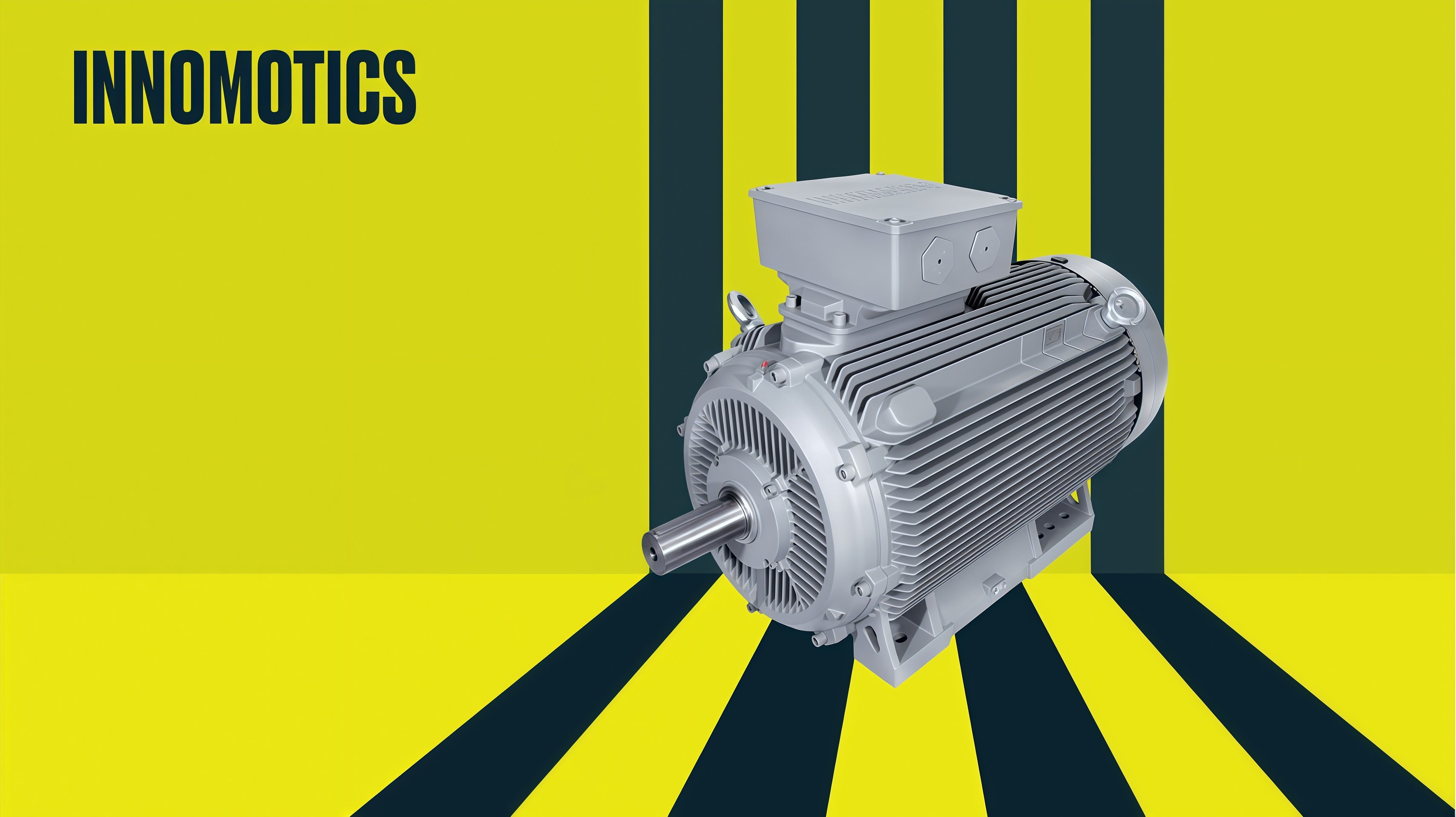
China INNOMOTICS Electromotor: High-Performance Drive Solutions for Industry
2026-11-16
Ask any plant manager about motor failure and you'll hear the same thing: it's never just a motor. It's a halted line, missed shipments, and a maintenance crew scrambling at 2 a.m. That's why Soochee keeps returning to the China INNOMOTICS Electromotor—not because it looks impressive on a spec sheet, but because it quietly handles the brutal, repetitive loads of real industry. In this post, we'll look at how this high-performance drive solution earns its place on the factory floor, and where it might fit into your own operation.
Built for the Load, Not Just the Spec Sheet
Anyone can print a datasheet full of impressive numbers. What happens when those numbers meet a real-world workload is a different story. We designed this system by starting with the hardest jobs our customers actually run—sustained heavy transfers, simultaneous multi-user access, and long-duration peak loads—then built outward from there. The result isn't a collection of theoretical maximums, but a machine that holds its ground when you push it past what the brochure suggests.
The difference shows up in the details that never make it onto a comparison chart. Thermal design that prevents throttling after hour three. Power delivery that stays stable when every drive spins up at once. Firmware tuned not for a single benchmark, but for the messy, overlapping traffic patterns of a busy production environment. These are things you only notice when you stop reading and start working.
Spec sheets tell you what a component can do in isolation. We care about what the whole assembly does when it's been running for a week straight, with no chance to cool down or catch its breath. That's why our validation process includes abuse tests that most vendors would call unreasonable—because your workload probably is too.
Cooling Paths That Keep Peak Torque Within Reach
Heat is the quiet torque killer. When cylinder head temperatures climb, knock sensors force the ECU to pull ignition timing, and that can chop 10-15 lb-ft off the midrange before the driver even feels a loss of power. A well-routed cooling path doesn't just lower the gauge reading; it keeps the exhaust valve seats and the combustion chamber walls stable enough that the engine holds its aggressive timing map. On boosted applications, directing a dedicated coolant line to the turbocharger bearing housing and then into the intercooler circuit prevents the intake air temp from spiking after back-to-back pulls, which is where peak torque usually disappears.
The drivetrain has its own thermal bottlenecks. A transmission that runs hot will start slipping the torque converter clutch earlier and shifting with less authority, robbing the wheels of the low-end punch that makes a car feel strong. An external cooler plumbed in series with the stock heat exchanger and a thermostatic bypass keeps the fluid between 170 and 190 degrees, right where the pump and clutch packs stay consistent. The same logic applies to a rear differential: a finned cover or a small pump-fed cooler stops the gear oil from thinning out, so the limited-slip unit can keep biasing torque to the outside wheel instead of fading into an open diff halfway through a corner.
Electric powertrains face a similar fight, just with different fluids. A stator jacket that circulates chilled coolant around the motor housing only cools the outer copper; the rotor and the magnets still soak heat from eddy currents. Spraying transmission oil directly on the rotor end rings through a hollow shaft pulls heat from the source that would otherwise demagnetize the permanent magnets. When battery cells are held in a narrow band with a low-temperature radiator loop, the inverter can keep delivering full current for repeated launches without derating. That's what keeps peak torque within reach when the session stretches past the first lap.
Winding and Core Materials Selected for Real Duty Cycles
Real duty cycles rarely match the steady-state conditions used in textbook design. Motors, transformers, and inductors in industrial drives or renewable energy systems often run for short bursts at high load, idle for long stretches, or face frequent reversals and voltage sags. Choosing winding and core materials based purely on nameplate ratings leads to early thermal aging or unnecessary bulk. Instead, the actual load profile dictates whether you need a high-temperature insulation class on the copper, a lower-loss core alloy, or a different stacking factor to handle peak flux without saturation.
For windings under intermittent overloads, rectangular copper conductors with thin, high-temperature enamel beat round aluminum wire when thermal cycling is aggressive. The copper's higher conductivity reduces hot-spot differential, while the enamel's flexibility prevents cracking during repeated expansion and contraction. On the core side, grain-oriented silicon steel works well for utility-frequency transformers with stable loads, but amorphous or nanocrystalline ribbons earn their keep in applications with frequent partial-load operation—think solar inverters or EV chargers—because their lower specific core loss flattens the efficiency curve across a wide load range.
Mechanical stress also sneaks into material selection when duty cycles include frequent inrush or short-circuit events. Core laminations with higher yield strength and a robust clamping scheme prevent gradual loosening that would otherwise amplify noise and vibration. Likewise, using a slightly thicker insulation film on the winding not only guards against voltage transients but also gives the turns enough rigidity to survive the magnetostrictive forces that peak during each energizing cycle. The goal is never to over-specify every part; it's to match the material's fatigue behavior and loss characteristics to the pattern of stress the equipment actually sees.
Drive Electronics Tuned to the Motor, Not Bolted On
Most drive systems treat electronics as an afterthought—a generic box bolted somewhere nearby, expected to work with any motor it happens to meet. This approach leaves performance on the table, forcing the motor and control electronics to compromise rather than cooperate. When the electronics are tuned specifically to the motor they command, the pair behaves like a single, unified machine instead of two components awkwardly sharing a power cable.
The difference shows up in how the system responds to load changes, how smoothly it accelerates, and how quietly it runs at low speed. A motor with matched drive electronics can anticipate its own thermal limits, adjust switching patterns to reduce harmonic noise, and hold torque with far less ripple. None of that is possible when the drive is a one-size-fits-all unit chosen from a catalog and mounted as an afterthought.
This integrated approach also simplifies installation and troubleshooting. Because the drive already knows the motor's inductance, resistance, and back-EMF profile, there is no guesswork during commissioning. The result is a drive system that feels less like a collection of parts and more like a purpose-built actuator—quiet, responsive, and predictable from the first power-up.
Uptime Numbers That Hold Up in Dust, Heat, and Vibration
Real uptime claims tend to crumble the moment you move past a clean, climate-controlled test bench. Dust fines work their way into connectors, heat softens solder joints and accelerates capacitor aging, while constant vibration loosens screws and fractures brittle leads. A number that survives all three isn't a marketing figure — it's evidence of conservative thermal design, thoughtful board stiffening, and connectors chosen for real mating cycles instead of lowest bill-of-materials cost.
Look for ratings that specify the environment, not just the hours. A 50,000-hour figure from a fanless sealed chassis with wide-temperature silicon means more than a longer number from hardware that assumes filtered intake air and a stable 25°C ambient. The difference shows up in corner cases: a hot afternoon on a gravel road, fine silica dust sifting through a cracked gasket, or a mounting bracket resonating at exactly the wrong RPM.
Field data separates honest numbers from wishful ones. When a vendor can point to units that logged tens of thousands of hours bolted to vibrating machinery or baking inside unventilated cabinets, the uptime claim carries weight. Anything less is a laboratory promise waiting to be embarrassed by a dusty Tuesday.
Retrofits That Fit Existing Mounting Footprints
Replacing an aging component rarely starts with a clean slate. The existing mounting holes, bracket spacing, and load-bearing points are already fixed in place, and any mismatch forces extra drilling, tapping, or welding before the new part can sit correctly. Retrofits that fit existing mounting footprints skip that step by matching the original bolt pattern and outline from the start. That means the new unit uses the same anchors, the same gasket surface, and the same center of gravity as what it replaces.
This approach shows up in upgrades like lighting retrofits where the fixture housing shares the old ceiling plate's hole spacing, or in pump swaps where the base frame lines up with the embedded studs already set in the floor. Because no new holes go into the roof, wall, or machine deck, the structural warranty and weather sealing stay intact. The labor saved is obvious, but the real benefit is avoiding the kind of misalignment that leads to vibration, leaks, and premature wear.
Not every replacement that claims to be a direct fit actually is, so check the tolerance stack. A mounting footprint that is off by a couple of millimeters in slot width or center-to-center distance can turn a quick swap into a full fabrication job. Good retrofit designs include slotted brackets, oversized washers, or spacer shims to absorb small site-to-site variations. The goal is not just to bolt on, but to stay put under the same loads the original was designed for.
FAQ
INNOMOTICS electromotors combine rugged construction with precision engineering, allowing them to maintain stable torque and speed even under fluctuating loads and harsh operating conditions common in heavy industry.
They use optimized electromagnetic designs and low-loss materials to achieve high efficiency classes, reducing heat generation and lowering long-term energy costs while still delivering the required mechanical power.
Sectors such as mining, cement, steel, chemical processing, and large-scale manufacturing gain the most, because these environments demand continuous operation, high starting torque, and resistance to dust, vibration, and temperature swings.
Yes, the design allows for tailored flange dimensions, shaft extensions, and cooling methods like forced ventilation or water jackets, enabling seamless integration into existing machinery without major modifications.
The motors are engineered to work smoothly with VFDs, offering wide speed ranges, low harmonic distortion, and reliable insulation systems that protect against voltage spikes during frequent starts and stops.
Bearings are overspecified and sealed against contamination, winding insulation is reinforced against moisture and chemical exposure, and protective coatings resist corrosion, all contributing to extended maintenance intervals.
Beyond the product itself, customers receive assistance with installation alignment, vibration analysis, and condition monitoring setup, helping to prevent unexpected downtime and maximize operational availability.
The switch often results in better thermal performance, lower noise levels, and higher tolerance to voltage imbalance, which translates into fewer nuisance trips and a more predictable production schedule.
Conclusion
China INNOMOTICS Electromotor answers a common frustration in industrial drives: motors that look right on paper but wilt under real operating conditions. Instead of chasing headline efficiency numbers alone, the design starts with load behavior, torque profiles, and thermal cycling as the actual engineering targets. Cooling is not an afterthought bolted around a generic frame; internal airflow channels and winding layout work together so that peak torque remains usable even during prolonged high-demand runs. Materials in the winding and core are selected for duty cycles that include frequent starts, stops, and overload bursts, rather than for a single ideal operating point. This means the motor’s stated performance holds up when it is pushed, not just when it sits in a clean test cell.
Drive electronics are matched to the motor’s electromagnetic signature, so switching harmonics and control response feel like one integrated system instead of a generic inverter strapped to a random machine. Durability claims are backed by uptime data collected in environments full of dust, heat, and vibration, where sealed bearings and reinforced terminal boxes prove their worth. For plants facing aging equipment, the retrofit story is equally direct: mounting footprints and shaft heights align with existing installations, cutting replacement cost and downtime. The result is a drive solution that speaks the language of maintenance teams and production managers, not just catalog engineers.
Contact Us
Contact Person: Jenny Jaa
Email: [email protected]
Tel/WhatsApp: 0086 152 9510 6006
Website: https://www.china-motor-supplier.com