
Best Ultrasonic Nozzle for Precision Coating and Fine Atomization
2026-09-01
Precision coating and fine atomization sound simple—until nozzle clogging, uneven spray patterns, or excessive overspray start eating into your yield. The difference between an acceptable coating and a flawless one often comes down to the nozzle you choose. In this post, we’re cutting through the hype to look at what actually makes an ultrasonic nozzle the best fit for demanding micro-coating tasks—and why Siansonic keeps showing up in high-stakes production lines.
Why Ultrasonic Nozzles Avoid the Clogging Problem
Ultrasonic nozzles work on a completely different principle than conventional pressure-fed spray systems. Instead of forcing liquid through a tiny orifice at high pressure, they rely on high-frequency vibration to atomize the fluid. The nozzle tip vibrates at tens of thousands of cycles per second, creating capillary waves on the liquid surface. When these waves reach a critical amplitude, droplets break away cleanly. Because the orifice itself can be relatively large compared to the droplet size, there is no narrow passage where particles can accumulate and form a blockage.
Another factor that prevents clogging is the self-cleaning action of the vibrating tip. Any solid particle that touches the surface is immediately subjected to intense acceleration, which tends to shake it loose rather than allowing it to stick. In contrast, pressure nozzles rely on tight clearances that easily trap debris. Many industrial users report that ultrasonic nozzles can run for hundreds of hours with suspensions or slurries that would quickly plug a standard air-atomizing or hydraulic nozzle.
The low-pressure operation also plays a role. Ultrasonic nozzles typically operate at pressures below 15 psi, often using gravity or a gentle peristaltic pump. There is no high-velocity liquid stream hammering particles into crevices. Combined with the wide flow path and continuous vibration, the system remains remarkably tolerant of particle-laden fluids. This is why ultrasonic nozzles are preferred in applications like nanoparticle coating, fuel cell manufacturing, and medical device spraying, where even brief downtime from clogging is costly.
The Link Between Frequency and Droplet Size
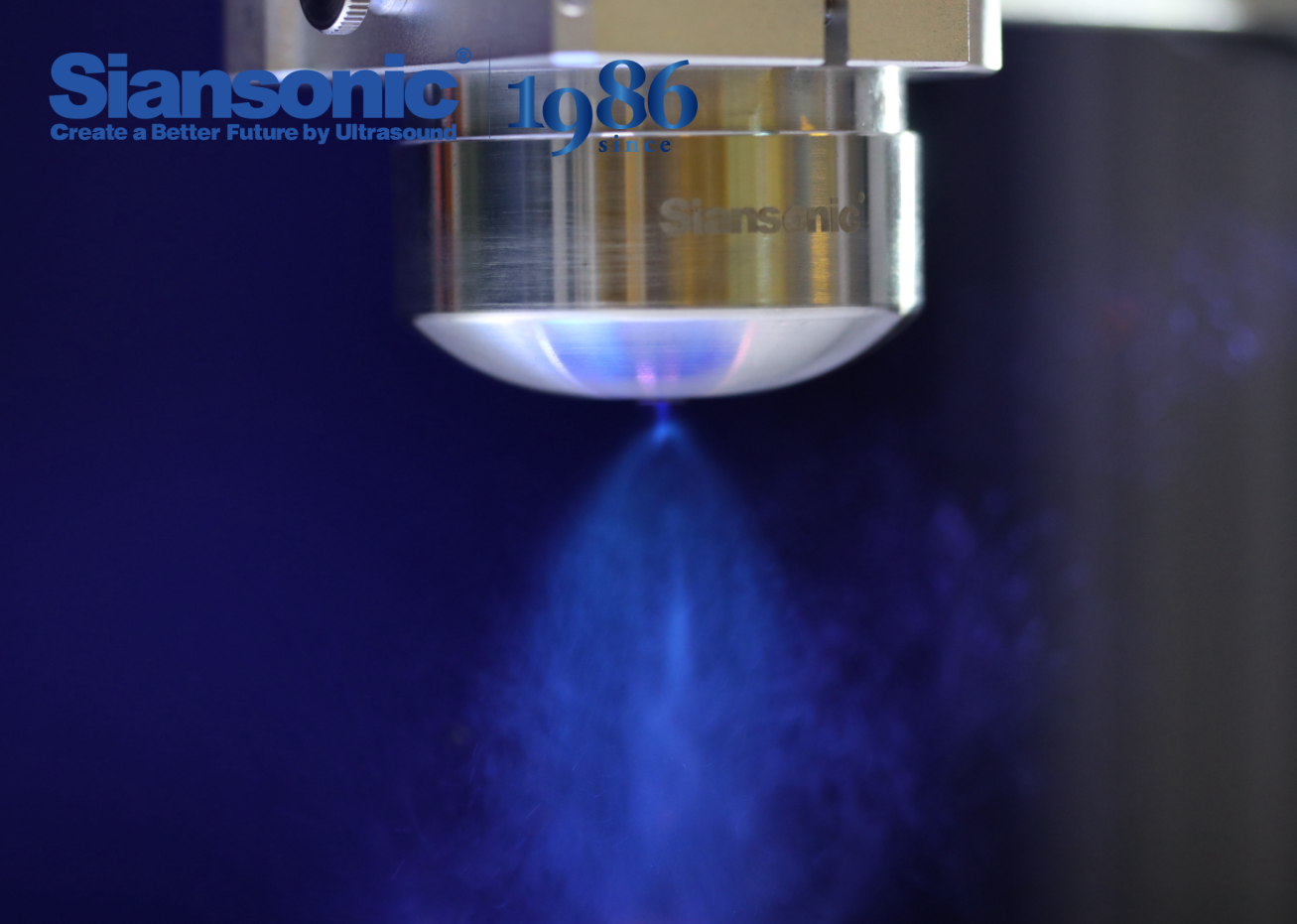
Droplet size in ultrasonic atomization is tightly coupled to the vibration frequency. As the frequency rises, the wavelength of the capillary waves on the liquid surface shortens, and the droplets that break away from those wave crests become smaller. This happens because the energy input per oscillation cycle fragments the liquid into finer parcels rather than allowing larger ligaments to form.
The relationship is usually expressed through an inverse power law, where droplet diameter scales roughly with the two-thirds power of the wavelength. In practical terms, a nozzle running at 20 kHz might produce droplets in the 90–120 micron range, while moving to 60 kHz can bring the median diameter down to 30–50 microns. The exact shift depends on liquid properties like viscosity and surface tension, but the overall trend holds across most low-viscosity fluids.
Engineers exploit this link when selecting atomization equipment. If a coating requires a very fine mist, a higher frequency transducer is often the first choice, though it may come with trade-offs in flow rate and power density. Lower frequencies, on the other hand, generate larger droplets and are better suited for applications where wetting or penetration matters more than mist fineness.
Coating Tight Corners Without Overspray
Spraying into a tight corner usually means the adjacent surfaces catch a fine mist before you even realize it. The fastest fix is to drop your fluid pressure and tighten the fan width. A narrow, soft pattern lets the finish settle into the seam instead of bouncing back at you, and it keeps most of the atomized paint from drifting onto the sidewalls.
Hold the gun slightly off-angle so the spray cone glances along the corner rather than hitting it head-on. For really sharp inside corners, slip a clean piece of cardboard or a flexible masking shield behind the target edge. Move the shield with your off hand as you work in short, controlled passes, releasing the trigger at the end of each stroke. This blocks the blowback and stops the sidewall from picking up dry dust.
If the corner is deep or the angle is awkward, switch to a smaller needle/nozzle setup or a detail gun. Lower air pressure also helps because high pressure creates more bounce and mist. A quick test on scrap with the same corner profile will show you whether the pattern is narrow enough before you commit to the actual workpiece.
Matching Nozzle Materials to Your Fluid Chemistry
Picking a nozzle material without checking how it behaves in your specific fluid is a fast way to ruin spray performance. Mild steel might hold up fine with plain water, but run a dilute acid through it and you will see pitting and clogging within days. Even plastics are not universally safe: polypropylene can swell and soften when exposed to strong ketones, while some nylons degrade in hot water or aggressive alkalis. The chemistry of the fluid controls the lifetime of the nozzle, so material selection has to come before flow rate or spray angle decisions.
Ceramics such as alumina and silicon carbide work well for highly acidic streams or abrasive slurries because they resist both corrosion and erosion. For broad chemical resistance, fluoropolymers like PVDF and PTFE handle everything from concentrated acids to solvents, though they cost more and can be fragile under high mechanical stress. Hardened stainless steels or tungsten carbide are better choices when the fluid is chemically mild but the operating pressure or particle load is high. Matching the material to the fluid means weighing chemical attack, temperature, and wear together, not just looking at a single compatibility chart.
Before finalizing a nozzle, run a small-scale soak test with the actual fluid at working temperature. Additives, impurities, or even small pH shifts can change how a material behaves, and a generic compatibility table will not capture that. Pay attention to seals and O-rings too, since a chemically resistant nozzle body means little if the gasket swells and leaks. In many cases, spending more on a ceramic or fluoropolymer nozzle up front avoids frequent replacements, downtime, and contamination of the sprayed product.
When Precision Coating Calls for a Pulsed Spray
Precision coating rarely forgives a heavy hand. On delicate substrates or tight-tolerance surfaces, a continuous spray can lay down too much material before the operator ever sees the buildup. Pulsed spray changes that by breaking the flow into short, controlled bursts, each lasting only milliseconds. The gaps between pulses let the coating settle or flash off slightly, which prevents pooling and keeps the wet film thickness far more consistent than a constant stream ever could.
The real advantage shows up on edges, recesses, and micro-features where fluid dynamics usually fight against uniformity. A pulsed spray delivers just enough material to wet the surface, then pauses long enough for surface tension to pull the liquid into place before the next shot arrives. This rhythmic application reduces overspray and bounce-back, so more of the coating ends up where it belongs instead of drifting into the air or clogging adjacent areas.
In labs and production lines alike, that kind of repeatability matters when you are working with expensive chemistries or parts that cannot be easily reworked. Whether it is a thin conformal layer on a circuit board or a low-viscosity primer on a metallic implant, the pulsed mode gives the applicator finer control over deposition. It transforms coating from a blunt instrument into something closer to a metering process, which is exactly what precision work demands.
Setup Details That Make or Break Atomization
The single most overlooked variable in atomization isn't the pump rating or the nozzle brand—it's the alignment tolerance between the liquid tip and the air cap. Even a 0.2 mm radial offset turns a clean cone into an asymmetric sheet that tears at the edges, producing coarse droplets and heavy bearding on the face. Most operators chase pressure when they should be checking concentricity with a pin gauge after every deep clean. A slightly worn centering pin or a galled thread will mimic all the symptoms of a clog, and swapping nozzles without verifying this fit only moves the problem around.
Flow path temperature gets ignored because it doesn't show up on the pressure gauge, but it changes everything. If the liquid arrives at the nozzle 8–10°C hotter than the surrounding air, the immediate flash evaporation at the orifice can collapse the spray angle before the droplets even form. Worse, a cold spot in the feed line creates intermittent viscosity swings—atomization stutters between fine mist and spitting. Run the line insulated, with a short unheated section right before the nozzle so the fluid reaches the tip at a stable, known viscosity rather than guessing from the tank reading.
Air assist cannot fix a bad liquid delivery pattern, but the reverse is true: a tiny change in liquid distribution can ruin an otherwise perfect atomizer. If the feed pump has a pulsation dampener set too soft, each stroke sends a pressure ripple through the nozzle that shows up as visible banding in the spray. You can't see it in a static test, only under a strobe or high-speed camera. Set the dampener charge to roughly two-thirds of the operating pressure, and reduce the distance from dampener to nozzle; every extra meter of tubing after it acts like a spring that amplifies ripple instead of absorbing it.
FAQ
Ultrasonic nozzles rely on high-frequency vibration from a piezoelectric transducer to break liquid into fine droplets, rather than forcing liquid through a small orifice under high pressure. This produces a softer spray with highly uniform droplet size and almost no overspray, which is ideal for delicate coating work.
Fine atomization creates droplets small enough to spread evenly across a surface, allowing very thin and consistent film layers. It also reduces material waste and prevents clogging issues that often occur with larger droplet sprays in tight-tolerance processes.
Electronics manufacturing, medical device coating, fuel cell production, glass and solar panel treatment, and textile finishing all see strong benefits. Any process demanding uniform thin films or selective area coating without masking can leverage ultrasonic spray technology.
Yes, they are particularly well suited for low-flow applications because the atomization does not depend on liquid pressure. Flow can be controlled precisely with a syringe pump or metering system, making it possible to coat at rates as low as a few microliters per minute.
Ultrasonic nozzles work well with low to medium viscosity liquids, suspensions, nanoparticle dispersions, and even some temperature-sensitive formulations. Very high viscosity fluids or those with large abrasive particles may not atomize cleanly and can damage the vibrating tip.
Regular cleaning of the atomizing tip with a compatible solvent prevents buildup that shifts the vibration frequency. The piezoelectric transducer should be checked for cracks or loose connections, and the nozzle must never run dry for extended periods, as this can overheat the tip.
Yes, ultrasonic nozzles respond almost instantly to on/off signals because there is no pressure lag or need to build up hydraulic force. This makes them excellent for pulsed coating, spot coating, and other non-continuous operations.
Key factors include the operating frequency, which affects droplet size, the liquid flow range, chemical compatibility of wetted materials, and whether the nozzle body fits your mounting and automation setup. It also helps to test with your actual fluid, since surface tension and solids content can change atomization behavior.
Conclusion
Ultrasonic nozzles earn their keep in precision coating because they sidestep the usual clogging headaches. Instead of forcing fluid through a tiny orifice, they route it through a comparatively open path and break it into droplets at the vibrating tip. That alone removes many of the maintenance stops that slow down production. But droplet size is not a guessing game—it tracks closely with frequency. Higher frequencies, such as 60 kHz or 120 kHz, produce finer, more uniform mists, which matter when you are laying down a thin conformal coat or targeting a small component. The low-velocity spray also lets you reach tight corners and recessed areas without creating overspray or bouncing material off the workpiece. And the nozzle material must match the fluid chemistry: titanium handles many common coatings, but aggressive acids or solvents might push you toward stainless steel or a fluoropolymer-coated horn. Ignore that match, and the nozzle degrades long before its expected life.
For small or intermittent patterns, a continuous spray often wastes fluid and drifts outside the target zone. Pulsing the ultrasonic nozzle gives you short, repeatable bursts that improve edge definition and reduce chemical use. Still, no nozzle fixes a sloppy setup. Liquid feed pressure, generator power, and nozzle-to-generator tuning all shape atomization stability. A stable, bubble-free fluid line and the right tip-to-substrate distance keep droplets consistent from the first part to the last. Cleaning the tip between runs and checking for buildup also prevent slow shifts in performance. In practice, the best ultrasonic nozzle for precision coating and fine atomization is less about a single part number and more about matching frequency, materials, pulse control, and process discipline to the job in front of you.
Contact Us
Contact Person: Ivy Zhang
Email: [email protected]
Tel/WhatsApp: +86 1081502288
Website: https://www.siansonic.com/