
Best Giant Press Brake Models for Heavy-Duty Metalworking
2026-10-16
In heavy-duty metalworking, the difference between a profitable job and a bottleneck often comes down to the press brake. But with so many "giant" models claiming massive tonnage, finding one that won't flex under pressure is harder than it sounds. That's why I've sorted through the top contenders—including some seriously robust machines from HUNSONE—so you can see which ones actually deliver on bending thick plate day after day.
Giant Press Brakes That Handle 1-Inch Plate Without Flinching
Most press brakes start to protest long before the material reaches a full inch. Frames twist, rams hesitate, and tooling takes a beating that nobody wants to pay for twice. The larger machines designed for this kind of work behave differently. They carry four-figure tonnage, beds that stretch beyond twenty feet, and frames deep enough to keep the load path straight. When a 1-inch plate hits the die, there is no flinch in the ram, no creak from the side housings, and no visible deflection at the center of the bed.
Repeatability tells the real story. Bending heavy plate is not just about making one part; it is about making fifty identical parts without drifting. On a properly built heavy brake, the ram rides in long, machined guides, and a crowning system works against the natural tendency of the bed to open up under full tonnage. That means the bend angle stays the same at the ends and in the middle. Shops running AR400 or A572-50 learn quickly which machines hold that line and which ones start producing scrap by mid-shift.
Tooling and setup also separate the serious heavy-plate brakes from the rest. One-inch stock needs tall punch bodies, hardened shoulders, and die openings wide enough to let the material form without bottoming out too early. Hydraulic clamping and quick-change die holders cut the time between jobs, but they also protect the tooling from the shock loads that come with thick plate. When the whole system is matched—brake, tooling, and crowning—the operator can focus on the part instead of fighting the machine.
The Truth About Tonnage Ratings on Heavy-Duty Bending Machines
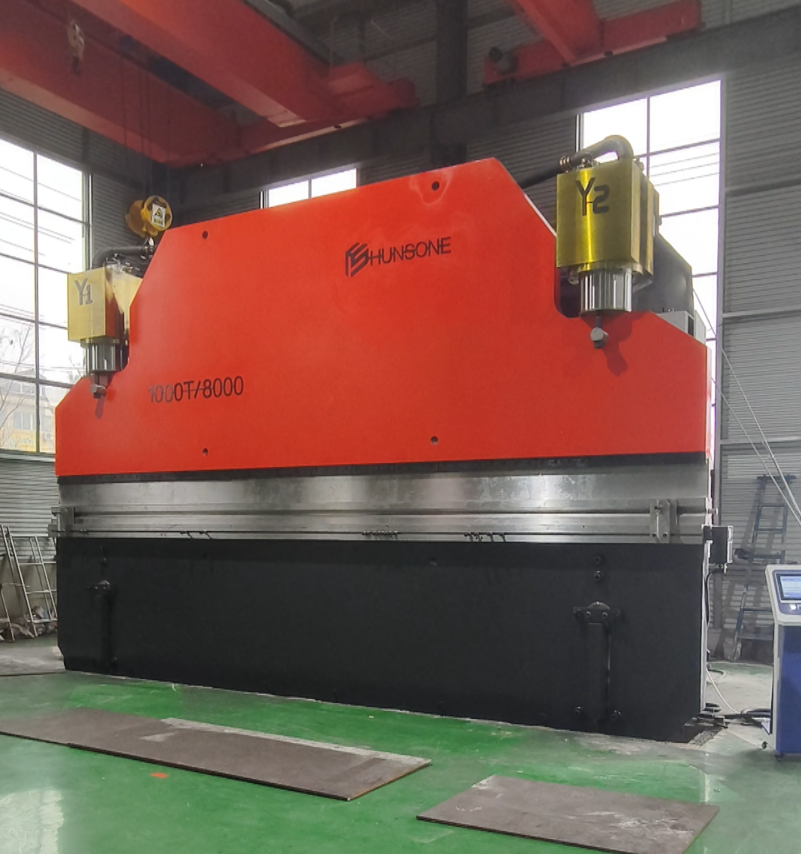
Many shops treat the tonnage number stamped on a heavy-duty bender as a promise, but it's really more of a starting point. A 200-ton machine won't bend every 3/8" plate the same way, because the actual force needed depends on the V-die opening, the material's tensile strength, and the bend radius you're trying to hold. If you're forming high-strength steel with a narrow die, you can easily push the load beyond what the rating suggests, even though the machine itself isn't defective.
The common mistake is to equate tonnage with maximum thickness capacity. That's only true under a specific set of tooling conditions. For example, a 175-ton press brake might handle 1/2" mild steel across a 10-foot bed with an 8x die opening, but switch to 1/4" AR400 and a tighter V, and the required force can double. The rating doesn't account for material springback, grain direction, or the localised stress at the die shoulder, all of which eat into the usable tonnage.
A more honest way to look at it is to treat the rated tonnage as the machine's absolute ceiling, not a work zone. Running continuously at 90–100% of that figure shortens ram and frame life, and overload alarms may not catch the spike from a misaligned back gauge or an off-centre bend. Experienced operators derate by about 20% for daily work, and they recalculate for every new material batch because mill certifications vary more than the sales brochure admits.
Hydraulic, Hybrid, or Electric: Matching Drive Type to Your Workload
Choosing between hydraulic, hybrid, and electric drive systems often comes down to how your machine actually spends its hours. Hydraulic drives still earn their keep in high-force, low-speed tasks where heat builds up and electric components would struggle to stay cool. If your workload involves long stretches of sustained pressure—like pressing, clamping, or lifting heavy loads—hydraulic systems provide a rugged, forgiving buffer that electric motors can't always match.
Hybrid configurations make sense when a single workload swings between extremes. You might need the quiet, precise movement of electric actuation for positioning, then a sudden demand for brute force that hydraulics deliver without breaking a sweat. The downside is added complexity and more maintenance points, so the hybrid route is best for facilities that already have technicians comfortable with both worlds.
Electric drives shine when energy cost and repeatability dominate the conversation. If your cycles are frequent, shorter, and demand exact positioning—think assembly, packaging, or cleanroom handling—electric systems cut out fluid leaks, warm-up times, and the constant monitoring that hydraulic oil requires. The higher upfront price often pays back only when the workload truly fits that profile, so before committing, map out real cycle times and peak force requirements rather than relying on a spec sheet.
Why Frame Design Separates Real Heavy-Duty Brakes from the Rest
The mounting points where a caliper bolts to the frame are rarely given much thought, but their stiffness directly shapes how braking force travels into the suspension. A flexy bracket or thin-gauge bracket area dissipates energy before it ever reaches the pad, making the lever feel vague and forcing the rider to squeeze harder for the same deceleration. Frames designed for serious heavy-duty use reinforce these zones with gussets, thicker wall sections, or forged dropouts, so the caliper stays perfectly aligned under load instead of twisting and wearing pads unevenly.
Heat is the silent killer of braking performance, and the frame acts as a heat sink whether the designer intended it to or not. On long descents or repeated hard stops, a brake can push rotor temperatures past 400 degrees Celsius, and the surrounding metal expands at a different rate than the caliper body. A well-designed frame accounts for this by leaving controlled airflow gaps around the caliper, using heat-tolerant alloys near the mounts, and avoiding paint or coatings that trap thermal energy against the brake. Without that foresight, you get brake fade that arrives earlier, fluid boiling, and eventually warped rotors that would have survived on a better frame.
Durability under repeated stress separates purpose-built heavy-duty brakes from those that simply look the part. Frames that route brake lines through sharp internal corners or rub against suspension pivots create wear points that fail slowly over months. Real heavy-duty designs use smooth external routing channels, protective sleeving, and reinforced cable stops that keep the hydraulic line stable during aggressive riding. The difference shows up most on bikes that carry cargo, trailers, or extra passengers, where every hard stop tests the entire system, not just the caliper and lever.
Tooling and Crowning Tricks for Repeatable Bends on Thick Steel
On thick plate, tooling selection outweighs raw tonnage. A wider V-die opening—typically eight to twelve times the material thickness—reduces bending force and prevents the punch from digging into the steel. Match the punch radius to at least one material thickness; anything sharper invites micro-cracking along the bend line. Sectioned tooling also helps, letting you shim individual segments to correct local angle drift without swapping the entire setup.
Crowning is where repeatability either holds or falls apart. Even a heavy press frame deflects under load, producing a canoe-shaped bend—tight in the center, open at the ends. Mechanical or hydraulic crowning systems work, but a simpler trick is to stack thin shims beneath the lower die at the center, adjusting the stack height while measuring angle on test strips at both edges and the middle. Once the crown profile matches your typical load, mark the shim arrangement and reuse it for that material and die combination.
Thick steel fights back through springback, and it varies with yield strength, grain direction, and even coil position. Track the actual overbend needed per heat number and record it at the machine. Keep ram speed consistent, and always measure at the same three points along the bend using a protractor or angle gauge. Clean, lightly lubricated tooling reduces galling and keeps the bend radius stable, so the first part of a new run lands close to the last part of the previous one.
What to Look for in Controls and Safety on Large Press Brake Installations
On a large press brake, the control system isn't just a screen and a few buttons—it's the difference between a smooth bend and a near miss. You want a controller that gives the operator real-time feedback on ram position, tonnage, and backgauge movement without burying critical data under three layers of menus. Look for intuitive jog modes, adjustable speeds for setup versus production, and the ability to store and recall tooling and angle corrections per job. If the interface forces a skilled operator to hunt for a simple offset adjustment, you're already losing time and inviting mistakes.
Safety on these machines goes well beyond a pair of light curtains. Large press brakes demand a layered approach: dual-hand controls that require simultaneous actuation, a properly interlocked sliding or hinged front guard that doesn't just stop the ram but also prevents restroking until reset, and side and rear barriers that account for long workpieces swinging during the bend. Pay attention to the stopping distance under full load—if the brake can't halt the ram within a few millimeters at top speed, even the best light curtain placement won't save a finger. Also check whether the safety circuit monitors hydraulic pressure decay, because a slow creep after the stop command is a silent hazard on high-tonnage frames.
Finally, consider how the machine handles fault recovery and maintenance access. A well-designed large press brake will let you lock out the ram mechanically, not just electrically, and will show clear diagnostic codes for every interlock rather than a generic "safety stop." Test the emergency stop under maximum tonnage: the ram should stop and hold position without drifting, and the reset procedure should require a deliberate two-step action. If the builder cuts corners here—using flimsy guard brackets, non-redundant limit switches, or a control that can be bypassed with a jumper—walk away. The best safety system is one that an operator can't ignore, disable, or outrun.
FAQ
Frame rigidity and bed length matter as much as tonnage. Machines like the Cincinnati CB series often pair boxed frames with oversized rams so deflection stays controlled even when you are working near the ends of a long bend.
Shops working with ship frames or wind tower sections frequently run Accurpress 7100 series or Amada HFE-M2 machines. Both hold angle tolerance across long beds, though the Amada leans more on servo hydraulics and the Accurpress on crowning tables.
A 1,000-ton press brake is not sitting on a standard 6-inch slab. Expect to pour an isolated pad or use a reinforced area rated for dynamic loading, and check for vibration transfer if other precision equipment runs nearby.
Rarely, unless a large contract depends on it. The machine cost, floor space, and setup time usually outweigh the benefit for occasional parts. Contract bending or partnering with a heavy fab shop often makes more sense.
Most serious models use CNC crowning combined with laser angle feedback that adjusts hydraulic cylinders in real time. That correction loop is the difference between a straight part and a reject with a visible center bow.
Hydraulic oil cleanliness becomes critical because valve blocks are expensive and downtime is brutal. You also need lifting equipment just to move tooling, and spare seals or servo valves can have lead times that stretch for weeks.
Yes, for pressure vessel and mining equipment work, though they are usually custom or semi-custom builds. The practical limit for standard catalogue machines is around 1,200 to 1,500 tons for most manufacturers.
You want hardened, segmented punches with a deep throat and quick-clamp systems. For plate over half an inch, plan on a die opening at least eight times material thickness and consider roller tooling if you cannot risk marking the surface.
Conclusion
When you're bending 1-inch plate day in and day out, the press brake has to be built like a tank. The best giant models don't flinch at that thickness because their frames are designed with deep, heavily ribbed construction that minimizes deflection under load. But don't just trust the tonnage rating stamped on the side—real-world capacity depends on tooling geometry, material tensile strength, and bend length. A machine claiming 500 tons might struggle with a tight radius on high-strength steel if the frame isn't rigid enough. That's why drive type matters too. Hydraulic systems still dominate for raw power and reliability, but hybrid and electric options are closing the gap, offering energy savings and faster cycle times for shops that run long production batches. Match the drive to your typical workload: if you're constantly pushing maximum tonnage, a traditional hydraulic setup with a heavy-duty ram is hard to beat.
Tooling and crowning make a huge difference on thick steel. Without proper crowning compensation, the bed and ram deflect in the middle, leaving you with inconsistent angles across the bend length. The top-tier giant press brakes come with automatic crowning systems that adjust in real time based on tonnage and bend width. Pair that with precision-ground tooling designed for heavy plate—like hardened V-dies with generous radii—and you can hold repeatable tolerances even on 1-inch material. On the safety and control side, look for modern CNC controllers that store complex bend sequences and automatically calculate bend allowance and tonnage requirements. Large installations also need robust light curtains, laser safety systems, and dual-hand or foot-pedal controls with redundant monitoring. The best machines integrate all of this seamlessly, so operators can focus on the work instead of fighting the machine. In the end, choosing a giant press brake isn't about one single spec—it's about how all these elements work together under real shop conditions.
Contact Us
Contact Person: James Chen
Email: [email protected]
Tel/WhatsApp: 86 13770803946
Website: https://www.hunsone.com/