
Air Cleaner Factory: Inside the Manufacturing Process Behind High-Quality Purification Systems
2026-11-16
Walk into any air cleaner factory and the first thing you notice isn't the machinery—it's whether the line is built for speed or for precision. At LUFUTATECH, high-quality purification systems come from a tighter process. Laser-checked housings, balanced motors, and filter seals are tested under pressure long before they reach your room. This behind-the-scenes look at manufacturing shows why the details on the factory floor decide how clean your air really is.
What Actually Happens Before the First Filter Gets Cut
Long before the blade comes down, the filter material itself is still just a loose, fluffy ribbon moving through a warm, slightly sticky room. Workers keep an eye on the tension and the spray nozzles, because if the bonding mist drifts even a little, the rod will either collapse or turn dense and hard. The fibers are pulled, relaxed, and pulled again until they settle into a consistent width and springiness. That quiet back-and-forth is where the real quality gets decided.
The wrapping paper has its own journey. It unwinds from a large roll, gets a thin line of adhesive, and is folded around the rod with just enough pressure to hold without crushing the air pockets inside. A set of sensors reads the rod’s diameter every few centimeters, and any bump or soft spot triggers a small flag. The rod that finally reaches the cutting station has already survived a dozen small rejections. So when the first filter is cut, it is not the beginning of the process, but the end of a long, careful argument between the material and the machine.
Where Filter Layers Are Stacked to Catch Particles Down to 0.3 Microns
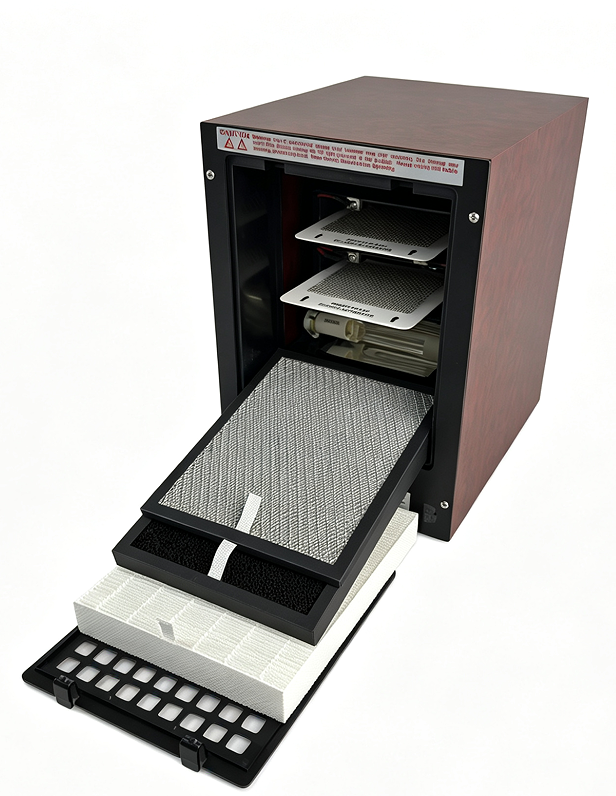
Inside the filtration chamber, each layer has a specific job. The pre-filter grabs larger debris—hair, dust clumps, pet fur—before they can clog the finer mesh. Then the activated carbon sheet absorbs odors and volatile organic compounds, leaving the air smelling neutral rather than just filtered. Finally, the dense HEPA-style layer traps the microscopic stuff: pollen, mold spores, bacteria, and particles as small as 0.3 microns. This stacking isn't arbitrary; it's a deliberate sequence that extends the life of the most expensive layer while maximizing what actually reaches your lungs.
The 0.3 micron threshold is often cited because it's the most penetrating particle size—smaller particles get bounced around by Brownian motion and hit fibers anyway, while larger ones are simply sieved out. By stacking layers with progressively finer pores, the pressure drop stays manageable, and the filter doesn't choke airflow. A single dense layer would clog in hours; a stack spreads the load. It's the difference between a filter that works on paper and one that still works after a month of bedroom use.
Maintenance also follows the stacking logic. You can vacuum or rinse the outer pre-filter weekly, but the inner HEPA layer should only be replaced every six to twelve months. Because the upper layers take the abuse, the critical micron-catching layer stays cleaner longer. That's why the stack order matters—not just which materials are used, but how they're arranged. A reversed stack would destroy the fine layer first and leave you breathing whatever slips through the coarse backup.
The Calibration Step That Keeps Motors Quiet and Rooms Fresh
A misaligned motor doesn't just hum—it complains. The calibration step addresses the small mechanical offsets and electrical timing errors that accumulate after installation or wear. Technicians adjust phase currents and sensor feedback so the rotor settles into a smooth, predictable rotation. Without it, even a new unit can develop a low-frequency drone that travels through ductwork.
This same adjustment influences how air moves. When fan speed is matched to actual static pressure, the system stops forcing too much or too little air through filters and coils. That balance keeps humidity in check and prevents stale pockets from forming in corners. Rooms feel fresher not because more air is moving, but because the right amount is moving at the right time.
The result is quieter operation and a more consistent indoor atmosphere. A well-calibrated motor runs cooler, draws less current at startup, and avoids the abrupt resonances that make occupants tense. It's a small procedure that often takes less than an hour, but it separates a system that merely works from one that disappears into the background.
Sealing the Housing So the Only Way Out Is Through the Filter
Most housings leave tiny gaps around the filter frame, and contaminated air sneaks past without ever touching the media. That’s not an oversight—it’s the weak point in too many designs. Sealing the housing changes this. Every seam, joint, and latch point gets a compressible gasket or a precision-molded lip, so the only path for air is straight through the filter. No shortcuts, no bleed air.
The effect is immediate in real use. You’ll notice the pressure difference when you open the unit after a few weeks: the filter is evenly loaded across its entire face, not just in a clean circle where airflow happened to be strongest. That even loading means longer filter life and less energy spent pulling air through a clogged center while the edges stay untouched.
It also changes how the machine behaves under load. Because the housing doesn’t flex or leak when the fan ramps up, the pressure stays where it belongs—pushing through the filtration layer. The result is a quieter, more predictable unit that doesn’t whisper dirty air around the seal when you least expect it.
Mixing Automation with Human Judgment on the Final Line
There's a quiet tension on any production floor where machines and people share the same space. Automation can churn through thousands of units an hour, but the final line still asks for something different—a pair of eyes that notice a slight misalignment, a hand that adjusts a seal before it ships. It's not about distrusting the robots; it's about knowing that the last few seconds before a product leaves the building are often the most human.
The trick is to let the automated systems do what they're best at—repetition, speed, consistency—and then deliberately slow things down at the end. That's where a worker might give a nod to a finished item, or reject one that passed the sensors but somehow feels off. This isn't a failure of the process. It's a deliberate design choice, mixing the cold certainty of code with the warm, imperfect judgment that only comes from experience.
The result isn't a compromise. It's a stronger final gate. Automation catches what would have been missed by fatigue, and human judgment catches what would have been missed by a narrow dataset. When both are given their place, the line doesn't just move faster—it moves with a kind of earned confidence that neither could produce alone.
The Last Check Before It Leaves the Factory Floor
Every unit rolls to a stop at the final inspection station, where the hum of machinery fades behind the focused quiet of human eyes and calibrated instruments. This isn't a cursory glance—it's a deliberate, line-by-line verification of torque values, surface finishes, and connector seating that earlier automated checks might have only sampled. The technician runs a gloved finger along a seam, checks the torque readout one last time, and logs the result with a hand scanner that beeps its approval into the production record.
What makes this final pass different from all the tests that came before is its stubborn insistence on the specific, not just the statistical. A batch may have passed its environmental stress screening hours ago, but here, each unit gets its own moment of scrutiny. A faint discoloration near a weld, a slightly stiff hinge, a label peeling at one corner—these are the things that get flagged and fixed before the pallet is wrapped. It's the difference between shipping a product that meets a specification and shipping one that survives a real customer's first unboxing.
Only after the check sheet is fully signed, the serial number scanned against the final test record, and the protective film applied does the unit move toward the loading dock. That last set of initials on the paper tag isn't just a formality—it's the quiet promise that nothing left this floor half-examined, half-trusted, or half-ready for the world outside.
FAQ
Most premium units layer a washable pre-filter for large dust, a pleated HEPA media rated H13 or higher, and an activated carbon bed or modified carbon cloth for gases and odors. Some designs add cold catalyst foam or molecular sieve blends to target formaldehyde and VOCs.
Every machine goes through a pressure decay test and often a tracer gas check while the filter is locked in place. Sealing faces use polyurethane foam gaskets or custom silicone extrusions, and any unit that falls outside the leak-rate window is pulled for rework before it can ship.
Brushless DC motors give finer speed control, lower energy draw, and much quieter operation at night. They also reduce vibration, which helps the housing stay acoustically tight over years of use.
The filtration assembly area is kept under positive pressure, operators wear lint-free gowns and gloves, and critical components like the HEPA pack are mounted inside laminar flow hoods. This prevents fibers, dust, and skin flakes from being sealed inside the unit.
Each sensor is challenged in a closed chamber with known concentrations of particulate matter or specific gases like formaldehyde. Readings are compared against a reference instrument, and any drift beyond a narrow tolerance triggers a full recalibration or replacement of the sensing module.
Housings are cycled between high and low temperatures, subjected to vibration tables, and sometimes dropped from a defined height to check for cracks or deformation. After each stress round, the unit is retested for air leaks and filter seating to confirm the seals still hold.
Yes. A random sample from each batch is pulled for full CADR measurement, cumulative clean mass testing, and noise spectrum analysis. The audit also checks power consumption at every fan speed and verifies that the display readings stay accurate after hours of continuous operation.
Conclusion
Long before a single filter sheet is sliced to size, the factory floor hums with preparation. Raw materials—fiberglass, synthetic polymers, activated carbon—are inspected for density, tensile strength, and resistance to airflow. Technicians compare incoming rolls against strict tolerance charts, rejecting anything that deviates even slightly. Once approved, the layers are stacked in a precise sequence: a coarse pre-filter to trap larger debris, then progressively finer media capable of catching particles as small as 0.3 microns. Alignment is everything; a single shifted layer would create a bypass path for contaminants, so laser guides and alignment jigs hold each sheet within a fraction of a millimeter before bonding.
After the filter core is assembled, attention turns to the motor and housing. Each fan unit undergoes a calibration pass where vibration sensors and sound meters measure rotational balance and noise output. Technicians adjust blade weights and bearing preload until the motor runs nearly silent, moving enough air to refresh a room without adding hum. The housing is then sealed with gaskets and ultrasonic welds, and pressurization tests confirm that the only route for air is straight through the filter media—no gaps, no leaks. On the final line, robotic arms apply adhesive and fasten panels, but human eyes still inspect every seam and latch, catching flaws that machines might miss. A last functional test powers the unit through multiple speed settings, checks the control board, and verifies airflow readings before the unit is boxed and sent out.
Contact Us
Contact Person: Paul Luo
Email: [email protected]
Tel/WhatsApp: 0086-19966314501
Website: https://www.lufutatech.com