
Air Bubble Detector Manufacturer: Ensuring Safety in Medical Infusion Systems
2026-10-01
One tiny air bubble in an IV line is all it takes to trigger a fatal air embolism. That stark reality drives every decision in infusion system design—and it makes choosing an air bubble detector manufacturer a matter of patient life or death. Siansonic has built its reputation on catching those bubbles before they ever reach a patient, combining ultra-fast response with robust, medical-grade reliability. Here's why their approach matters for the future of infusion safety.
Why Air Bubble Detection Remains a Critical Safety Net in Infusion Therapy
Even with advanced infusion pumps and careful line priming, air can still enter the tubing through micro-leaks, temperature changes, or accidental disconnections. A dedicated air bubble detector acts as the last line of defense, catching what the human eye might miss during busy clinical shifts. Without this safeguard, small bubbles could accumulate and lead to air embolism—a rare but potentially fatal complication that no clinician wants to face.
The value of real-time bubble detection goes beyond just sounding an alarm. It gives nurses and caregivers the confidence to focus on patient assessment rather than constantly staring at the drip chamber. Modern sensors can distinguish between a harmless micro-bubble and a clinically significant air column, reducing false alarms while still interrupting flow when it truly matters. This balance between sensitivity and practicality keeps infusion therapy both safe and efficient.
In home infusion and ambulatory settings, where patients manage their own pumps, automatic detection becomes even more critical. Users may not have the training to spot subtle changes in fluid movement, and a missed bubble can travel silently through the line. By integrating detection directly into the pump mechanism, manufacturers create a invisible safety net that works around the clock—protecting patients even when attention wavers.
Inside the Engineering: How Modern Detectors Sense Even Microbubbles
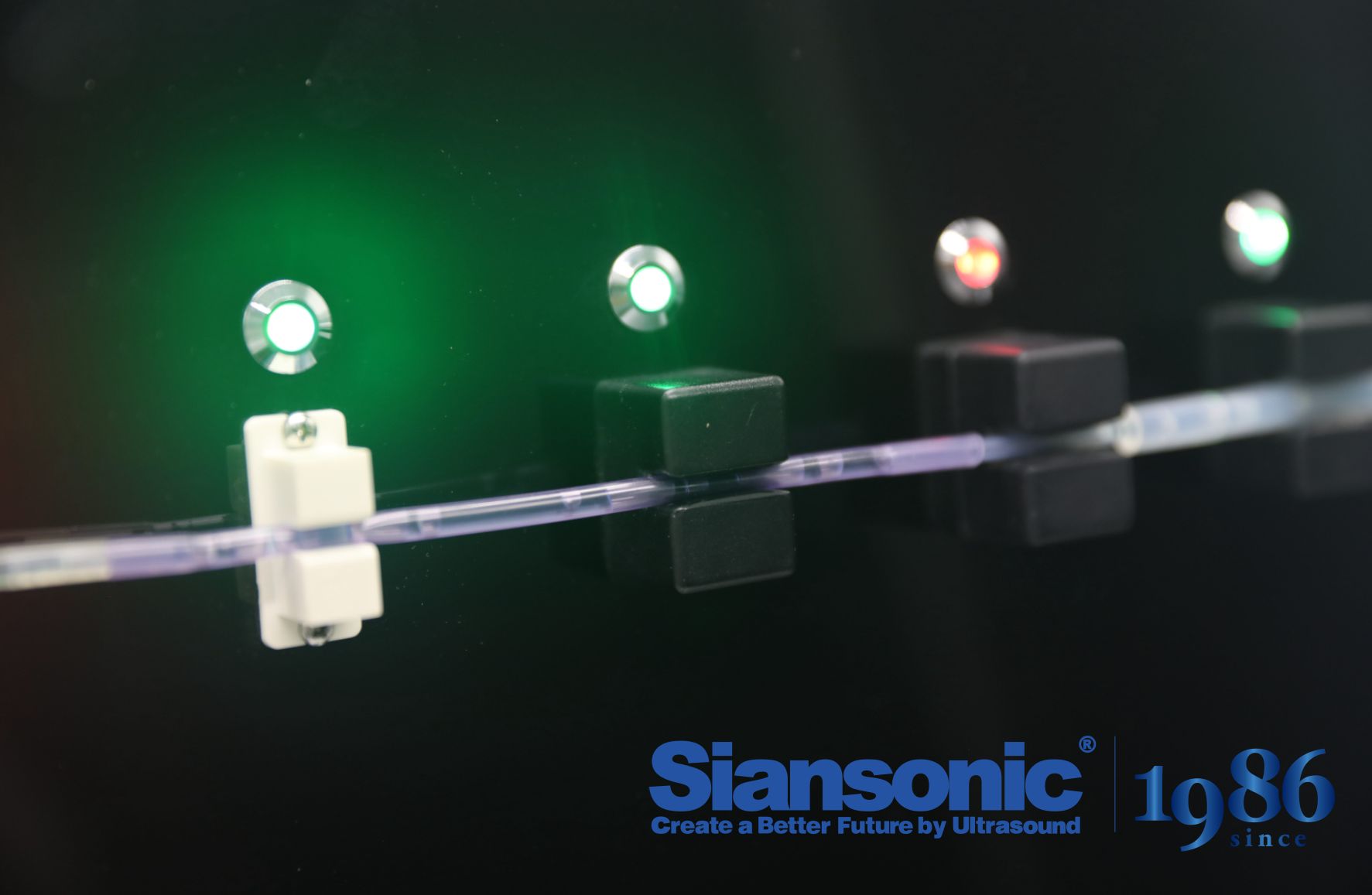
Most people imagine a bubble detector as a simple float switch, but modern engineering has moved far beyond mechanical flappers. The real challenge isn't spotting a large air pocket—it's catching microbubbles smaller than a grain of sand, often while fluid flows at several liters per minute. To manage this, detectors rely on a pairing of piezoelectric ceramics and tuned resonant chambers. When even a 20-micron bubble passes through the sensing zone, it momentarily changes the acoustic impedance. That tiny shift alters the standing wave pattern, and the ceramic element converts the pressure difference into a measurable voltage spike. It's less like listening for a pop and more like detecting a single off-key note in a symphony.
The tricky part is filtering out noise. Pump vibrations, valve closures, even the turbulence from a nearby bend in the tubing can generate signals that look almost identical to a microbubble event. Engineers solve this with a combination of narrow bandpass filtering and adaptive thresholding. The detector learns the baseline acoustic signature of the liquid during normal operation, then looks for transient deviations that match the expected rise time and decay of a real bubble passage. Some units go further by using two sensing elements spaced a few millimeters apart. A genuine bubble produces near-identical signals on both elements with a microsecond delay, while random noise rarely correlates that cleanly. This cross-correlation trick drops false positives to less than one per ten thousand cycles.
Material choice also plays a surprisingly subtle role. The sensing chamber can't simply be any rigid tube—if its acoustic properties resonate at the same frequency as the drive signal, standing waves become unstable. Modern detectors often use polyether ether ketone (PEEK) or polished borosilicate glass for the flow cell, tuned to have a high mechanical Q factor but slightly off-resonance from the excitation frequency. That keeps the background signal stable so the electronics can amplify only the delicate perturbation caused by a passing microbubble. It's an engineering balance between sensitivity and stability: too sharp a resonance and the detector rings like a bell, too dull and the microbubble disappears into the noise floor.
Regulatory Demands and the Role of Specialized Manufacturers
Navigating the labyrinth of modern regulatory demands has become a defining challenge for manufacturers across industries. From evolving environmental standards to sector-specific safety protocols, the burden of compliance often stretches internal resources thin. Specialized manufacturers step into this gap not merely as suppliers but as strategic partners who embed regulatory intelligence directly into their production DNA. Their focused expertise allows them to anticipate shifts in requirements—whether it’s new emissions thresholds, material traceability rules, or labeling mandates—and adjust processes before non-compliance risks escalate.
What distinguishes these specialized players is their ability to convert regulatory complexity into operational advantage. Rather than treating compliance as a reactive checklist, they build quality management systems that align with multiple jurisdictions simultaneously. This is particularly valuable for companies operating across borders, where a single product might need to satisfy divergent standards in the EU, North America, and Asia. Specialized manufacturers often maintain dedicated regulatory affairs teams, invest in certification-heavy production lines, and document every step of the value chain with forensic precision. The result is a smoother path to market for their clients and a substantial reduction in audit-related disruptions.
The collaboration between original equipment manufacturers and specialized producers also reshapes risk allocation. By outsourcing components or entire subassemblies to partners who live and breathe regulatory nuance, brands can focus on core innovation and customer experience. This division of labor doesn’t dilute accountability; instead, it creates a layered defense where each party owns the compliance of its specific contribution. In sectors like medical devices, aerospace, or specialty chemicals, such partnerships have become almost indispensable—proof that when regulation intensifies, the role of the specialized manufacturer expands from niche vendor to essential infrastructure.
Beyond the Hospital: Expanding Use Cases for Bubble Detectors
Bubble detectors have long been synonymous with patient safety in hospitals, but their utility does not stop at the ward doors. In brewing and beverage production, these sensors catch unwanted gas pockets that can ruin batch consistency or cause overflows. A microbrewery in Oregon, for instance, uses inline bubble detectors to monitor carbonation levels during canning, adjusting flow rates on the fly.
The diving industry offers another surprising frontier. Rebreather systems, which recycle exhaled gas, rely on bubble detectors to spot dangerous gas leaks before they escalate. Technical divers in cave environments pair these sensors with audible alarms, turning a silent threat into an early warning. This same principle now guides aerospace engineers testing fuel lines for trapped air pockets that could destabilize a rocket's thrust.
Even in food processing, bubble detectors are becoming unsung heroes. Dairy plants use them to verify that homogenization has not introduced micro-foam into milk, which can shorten shelf life. Meanwhile, research kitchens experimenting with sous-vide techniques use portable bubble detectors to ensure vacuum-sealed bags remain airtight during long cooks. These examples show that the technology's real power lies in adapting a simple physical principle to very different workflows.
Selecting a Manufacturing Partner: Questions That Matter
The right manufacturing partner can make or break a product launch. Before signing anything, dig into their actual production capacity. A factory might claim they can handle 50,000 units a month, but ask what happens when your order doubles or a key machine goes down. Tour the floor, talk to line workers if possible, and check whether their equipment is maintained or just patched together. Capacity on paper rarely matches the reality of peak season.
Quality control is another area where assumptions cause trouble. Ask for samples from the exact production line your order will run on, not a curated prototype. Find out how defects are caught, what percentage get reworked, and who pays for scrap. A partner that cannot explain their inspection process in plain terms is likely hiding gaps. Also ask how they handle supplier changes for raw materials, since a cheaper sub-supplier can quietly lower your product's durability.
Communication habits will shape every delay and design tweak. Do they give you one point of contact or bounce you between departments? Test their response time with a simple question before placing a large order. Also raise intellectual property early: request signed confidentiality, ask where your files are stored, and confirm they won't run a "midnight shift" for another client. A factory that gets defensive about these questions is telling you something worth listening to.
The Next Wave: Smart Sensors and Predictive Infusion Safety
Infusion pumps have long relied on rate calculations and occasional pressure alarms, but the next shift moves sensing directly into the line and the patient. Disposable flow sensors built into the cassette can now detect subtle changes in backpressure that indicate an infiltrated IV or a kinked catheter before the nurse sees swelling. These are not threshold-triggered alarms; they track a rolling signature of resistance and flag deviations that match known failure patterns.
Predictive safety adds another layer by pulling in patient context. A sensor may notice a gradual rise in line pressure that, combined with a falling pulse oximetry trend or a rising heart rate from the monitor, suggests the line is degrading rather than simply occluded. The pump then lowers the infusion rate or pauses delivery while notifying the right clinician, instead of waiting for a hard occlusion alarm that often arrives after the medication has already pooled under the skin.
The hardest problems are not in the sensors themselves but in making the predictions trustworthy across busy units. False positives erode confidence faster than missed events. That is why newer systems are being tuned on real-world data from oncology, neonatal ICUs, and outpatient parenteral therapy, where infusion failures carry very different costs. A smart sensor that understands those differences can reduce alarm fatigue and actually prevent harm, rather than adding another beeping box to the room.
FAQ
Peripheral lines can tolerate tiny bubbles absorbed in capillaries, but central venous catheters present a direct path to the right atrium. Detectors configured for central line use therefore use tighter thresholds and faster alarm responses, often reacting to bubbles as small as 50 microliters within one second.
Beyond the transducer itself, a specialized manufacturer provides clinical risk documentation, tubing compatibility matrices, and traceable validation against IEC 60601-2-24. They also offer firmware integration support so the alarm logic aligns with pump safety architecture instead of acting as a standalone afterthought.
Lower frequencies around 1 to 2 MHz penetrate deeper and tolerate wall thickness variations, while higher frequencies above 5 MHz resolve smaller bubbles but are more sensitive to alignment errors. A manufacturer that offers multiple frequency options lets device developers balance sensitivity with mechanical tolerance.
Tubing paths with continuous taper and no dead legs reduce gas accumulation. Some detectors use a brief in-line flush cycle or software filters that ignore stationary echoes, focusing only on moving bubble signatures. Proper wetting of transducer faces also eliminates micro-air layers that mimic bubbles.
Accelerated aging tests at elevated temperature and humidity expose drift in sensitivity and baseline noise. Manufacturers should provide drift specifications, such as less than 5 percent sensitivity change over five years, along with recommended recalibration intervals and built-in self-test routines.
Optical detectors work well in clear tubing with transparent fluids, especially in laboratory or non-critical infusion where cost is a dominant factor. However, for blood products, lipid emulsions, or opaque tubing, optical methods struggle, making ultrasonic the safer choice in clinical environments.
Air bubble alarms typically rank above low battery and occlusion warnings but below critical system faults. Manufacturers implement alarm escalation protocols in firmware so a bubble alarm can mute non-urgent alerts and trigger immediate pump stop, but still allow a clinician to temporarily override for line clearing only with confirmation.
Test rigs inject air through micro-syringes during temperature cycles and after fluid bag changes to mimic outgassing and line manipulation. Protocols also include vibration tables and drop tests to ensure detector mounting does not loosen, because mechanical resonance can mask or amplify bubble signals.
Conclusion
Air bubble detectors remain an underappreciated safeguard in infusion therapy. Even a tiny air embolus can travel to the lungs or brain, causing serious harm, so the detection of microbubbles isn't a luxury—it's a clinical necessity. Modern detectors rely on ultrasonic or optical sensing, often paired with sophisticated algorithms that distinguish true bubbles from harmless flow noise or tubing artifacts. This engineering precision matters because regulatory bodies like the FDA and EU MDR demand rigorous validation, and specialized manufacturers must navigate those demands without compromising real-time responsiveness. The result is a component that quietly prevents catastrophic failures while nurses and physicians focus on patient care.
Hospitals are only part of the story. Bubble detectors now appear in home infusion pumps, dialysis machines, and even bioprocessing lines where air contamination ruins batches. When selecting a manufacturing partner, smart buyers look beyond spec sheets: they ask about sensor stability across temperature shifts, long-term drift, and the ability to customize alarm thresholds. The next wave adds predictive analytics—sensors that don't just flag bubbles but anticipate degassing events or tubing wear before they become dangerous. A capable manufacturer becomes more than a supplier; it becomes a co-developer in safer infusion systems.
Contact Us
Contact Person: Ivy Zhang
Email: [email protected]
Tel/WhatsApp: +86 1081502288
Website: https://www.siansonic.com/